Showing posts with label thriller. Show all posts

Sunday, August 11, 2019

The Gangster, the Cop, the Devil

The Gangster, the Cop, the Devil is not an imaginative film title, but at least we have a pretty good idea what the film is about. Detective Jung Tae-seok is a tough, cynical cop who has a personal vendetta again powerful gangster Jang Dong-soo. He puts 2 and 2 together when investigating a random killing of guy found stabbed to death in the back of his car. He decides this murder has a similar M.O. to a couple of older crimes in other towns and decides there is a serial murderer to be caught. His wild theory is not taken seriously, even when Jang Dong-soo is attacked when driving home one night. The gangster fights back and survives the attack, thinking he'd been attacked by a hitman sent by a rival starts a gang war and also sends his men out to look for the assassin. The cop notices that both cars had been hit from behind by a white car and realises that Jang Dong-soo is the only person to have seen the serial murderer's face. Eventually, the erstwhile enemies join forces to hunt down the killer who has become more reckless, killing more frequently and not changing location like he used to.

The Gangster, the Cop, the Devil is a stylish South Korean action crime thriller. The cops are unkept, the police station dingy and crowded, while the gangsters are stylish, impeccably dressed and vicious. While the presentation is stylish, the scenario and plot are as original as the title. It is best to go along for the ride rather than look for novelty or a deeper message. But this is no different from many Hollywood films that do well at the box office. The Gangster, the Cop, the Devil stands up well alongside those films.

I think that the downfall in The Gangster, the Cop, the Devil is the serial killer - "the Devil". Surely the idea of the uber-villain should be confined to cinematic and TV history. The idea that a single man (and it is almost always a man) who can out-think and outmanoeuvre the cops, often depicted as planning things years in advance, setting up elaborate one-off schemes and having limitless resources as his disposal yet having a secret room where he pins pictures of his victims and future victims to the wall along with newspaper clippings and decorated with his primitive art that lays bare his inner thoughts and as a shrine to his evil crimes is completely ridiculous. The serial killer in The Gangster, the Cop, the Devil is a ruthless, knife obsessed loner, whose main defence is his anonymity and that his kills have been in different police districts, with long gaps in time between them. Once he starts to kill more frequently and staying in the same area, he should have ceased to be the formidable opponent he was built up to be.

The best scene is a throwaway scene where we are shown a potential female victim only to have our expectations amusingly upended in a unique insight into the idea that one of the protagonists may have a life outside work.

🎥

Ian rating 3/5

Wednesday, August 07, 2019

The Nightingale

Jennifer Kent is best known for her controversial horror film The Babadook. Her latest film is set in Tasmania during the convict era and centres around Clare an Irish convict who has served her time, got married to another Irish ex-convict, had a baby but can't leave the tiny settlement she lives in until the lieutenant in charge writes her release letter. She works as a servant and singer and the whole garrison, from Lt Hawkins down, openly lusts after her. Clare is near the bottom of the social pecking order, constantly at risk of harm to her and her family, while trying to insist on her right to be treated as a free person. A visit from a more senior officer starts the chain of events that brings down an avalanche of violence on Clare. With nothing left to lose except her life, Clare sets out to into the bush with Billy (a reluctant Aboriginal tracker) to get revenge on the Lieutenant (who left with a small contingent a few hours earlier). The film follows the two groups through the bush to Launceston. While initially a backdrop to Clare's story, the war against Aboriginal Tasmanians becomes the second theme of the film and Clare's initial attitude to Billy is no different to the soldiers' attitude. As Billy explains his history, Clare slowly begins to see him as a fellow victim.

The Nightingale doesn't shy away from violence and the body count here rivals a Quentin Tarantino film. The film is a rollercoaster with each rise in fortune followed by a crashing fall. This isn't a happy story, it is one that asks us to understand the use of violence and whether violent revenge puts an end to the original violence or just creates a cycle and an excuse to continue with violence.

🎥

Ian's rating 4/5

Sunday, August 04, 2019

Monos

Phrases such as "Like Lord of the Flies", "Apocalypse Now on shrooms", "In the place of warfare are bizarre rituals, horny hook-ups and campfire raves", and "a tense, off-kilter deep dive into corrupted innocence that never quite goes where you think it will" lowered my expectation of Monos.

Monos has the most diverse set of actors I have seen in a long time. Which is handy in an ensemble film, where 8 to 10 characters are sharing the spotlight and dialogue is sometimes sparse. Eight child soldiers are left on a bare mountain top to guard an American hostage by their roving commander (who is shorter than some of his young soldiers). The teens belong to a rebel group whose ideology and aims are never explained. The views from this vantage point above the clouds are spectacular. But there is not a lot of soldiering to do, so plenty of time bored teenage mischief. But in the second half of the film, things change gear. The soldiers and their hostage move down into the rain forest. We only get vistas from drone footage, the characters inhabit a much more damp and claustrophobic world where you can rarely see more than 2 or 3 metres in any direction. Group dynamics change when their prisoner makes a break for freedom. Loyalties are challenged and the body count mounts.

We are tempted to take sides but is anyone on the side of the angels? Director Alejandro Landes keeps us guessing and keeps reminding us that these are both kids and killers. While not a great film it was better than I expected when I found my seat. Visually interesting, thrilling, twisted and morally ambiguous.

🎥

Ian's rating 3/5

Sunday, July 28, 2019

Fly By Night

Do you like your gangland boss to chuckle and gloat over his victims? Do you like your detective to be cool and suave? Do you like to see your protagonists trapped in an impossible situation? Fly By Night ticks all these boxes and more. While there is nothing new in the plot, it more than makes up for that in style and tension. The protagonists are a small family taxi company in Kuala Lumpur which supplements its income with slick an extortion racket that operates below the radar of both the local gangsters and the police ... until a mark unexpectedly escalates things and one of the boys is a sore loser at the neighbourhood casino bring the family to the attention of the owner (played by Frederick Lee channelling Jack Nicholson in a scenery-chewing performance). Meanwhile, Inspector Kamal is lazily circling the family like an inquisitive shark.

Fly By Night film poster
Who is who?
It took a few minutes to work out the relationships between the characters at the start of the film and the ending is ambiguous. But otherwise, this is an enjoyable, often funny ride where, like a traditional noir, no-one is good - even the wronged girlfriend. The action scenes are sharp. There is no shortage of violence. And New Zealand gets mentioned a couple of times.

🎥

Ian's rating 3.5/5

Monday, August 13, 2018

The Reports on Sarah and Saleem

We've seen quite a few movies about Palestinians who live in the West Bank (Paradise Now, A Wedding in Ramallah, Omar, Private, The Zoo) but few about Palestinians who are Israeli citizens. So  The Reports on Sarah and Saleem broke some new ground in terms of both that and interaction between Jewish and Arab Israeli citizens.

So in this movie, Sarah is a Jewish Israeli cafe owner, and Saleem is a Palestinian who delivers croissants to her cafe. They move in different circles but they both live in Jerusalem. They both have distracted spouses - Sarah's husband David is an officer in the IDF and is often away and Saleem's wife Bisan is pregnant and is declining sex because it's bad for the baby. So they have motive, proximity and opportunity for the affair they embark on. The bakery van provides a handy venue. You could say their affair was bound to lead to trouble but it seemed harmless enough initially.

The event that really starts the trouble is a late-night trip to Bethlehem. Despite the plan to pretend Sarah is foreign by having her only speak in English, she's rumbled as Jewish and some unhappy Arabs not only give Saleem a hard time, they report him to the authorities, and things escalate from there.

Any affair has potentially troublesome ramifications and I guess the plot revolves around the many ramifications that this affair had, in this politically and racially charged part of the world. Many of them were unexpected, and I was never bored and never knew quite what was going to happen next. This movie is quite woman-centric for a Middle-Eastern film and I liked how Sarah and Bisan didn't just roll over and do what their husbands wanted. I liked how interesting and well-acted some of the lesser characters were - Saleem's lawyer Maryam and the bald Israeli security guy in particular..

Jerusalem looked beautiful as always and the similarities and differences between Jewish and Arab Israelis were nicely highlighted.

Anne's rating 4.5/5 Ian's rating 4.5/5

Sunday, August 12, 2018

The Guilty

The detectives who feature in crime novels, particularly Scandinavian ones, are usually troubled souls. They're a bit too devoted to their jobs, and as a result their relationships fail. They're a bit prone to cutting corners to get a result in a case, and so are often in trouble with their bosses but they inspire complete loyalty from their work partners.

Asger Holm, the star character in The Guilty is just such a Scandinavian police officer. He's been suspended from regular police duties since he shot a criminal and has been reassigned to working in the call centre answering 112 emergency calls. A routine evening in the centre is coming to an end when a woman who has been abducted by her husband phones in and we see Asger's detective and organisational skill at work despite him never leaving the desk.

Asger is a huge character and he features in every scene. He's compassionate and thoughtful, persuasive, determined  and unwavering. He's a classically flawed hero and he is totally worth watching - both for his character and his hugely expressive and largely flawless face.


The film is very clever, with the plot detail  unfolding with each phone call between Asger and the woman  (Iben), and Asger and Iben's daughter, a Asger and the staff who dispatch offices and cars around the city . (The instant nature of the dispatches is truly impressive if you've ever been made aware of New Zealand's rationing of police resources). Despite being filmed entirely in the call centre, the Guilty keeps you on the edge of your seat, as a thriller should, and the realisation that things are not exactly as you first thought is nicely gradual.

Anne's rating 4/5, Ian's rating 4.5/5

Wednesday, August 08, 2018

Beirut

So far this is the most gripping film of the 2018 NZIFF. A spy noir. Unusually for an American spy movie, Beirut is more John le Carré than Jason Bourne. This is the movie where you don't want to miss a line of dialogue. Working out everyone's motives and relationships is important.

Beirut sets the scene in 1972 at a party thrown by American diplomat Mason Skiles at his mansion in the hills above Beirut. The party is gatecrashed at the front door by the CIA and Mossad and at the back door by gunmen and his wife is killed. Jumping forwards to 1982 and Skiles has left the diplomatic service and is working as a negotiator in a labour dispute and is reputed to be an alcoholic. But an American has been kidnapped in Beirut and Mason is asked to come out of retirement and negotiate with the kidnappers. Mason arrives in a very different Beirut, the Lebanese Civil War occurred while he was away and everyone thinks that Israel is about to invade. Mason not only has to work out what the kidnappers want and what he needs to do to get the kidnapped man released but also deal with factions at the U.S. Embassy who have their own priorities, which include encouraging the Israelis to invade.

This is a movie that may reward a second viewing as I am not sure I picked up on all the minor plot lines, particularly for characters who suddenly reappear after being absent for much of the film. There are no flashy stunts, our hero knows what to say to achieve something rather than how to leap between tall buildings.

The has-been that everyone has written off but gets to make a comeback is a staple lead character in Hollywood movies. It is a way of getting sympathy with the hero and separating them from the other characters in the story.

That said this film is not without faults. There are at least 9 significant characters, some of whom don't get much screen time. So most of the characters are pretty thin, but it is their motives that are important rather than their personality. All but 2 of these people work for governments (or the P.L.O.), so their personal stories take back seat while they do their jobs. For a film set in Beirut there are no significant Lebanese characters and in typical Hollywood-fashion Arabs are portrayed as violent, uncivilised characters always out for revenge and to be killed with impunity. While the Israelis are not the good guys in this film at least they get some minor parts, and there is disillusionment with the American government.

Beirut was filmed in Tangier, Morocco. Which apparently has a significant number of half-demolished buildings.

🎥

Ian's rating 4.5/5 Anne's rating 3.5/5

Tuesday, August 15, 2017

Human Traces

I was a bit concerned about Human Traces being a throwback to the twentieth century's long tradition of dark and depressing New Zealand films. A thriller filmed on a sub-antarctic island didn't really hold much promise for breaking out of that mold,  and the first section of the film didn't seem to either. On the other hand the acting talent was good - Sophie Henderson did an amazing job in Fantail and Mark Mitchinson was a practised and convincing bad guy in both Nothing Trivial and Bloodlines.

The story centres around husband and wife Sarah (Sophie Henderson) and Glenn (Mark Mitchinson) who are two-thirds of a team of three monitoring the eco-system of an un-named island south of New Zealand.  Sarah is young and blonde and pretty, and Glenn is a somewhat morose character who is at least twenty-fives years her senior. They met when he was one of Sarah's lecturers at university.The film begins as the other team member leaves and her replacement (Pete) arrives. Pete is also young and beautiful and doesn't have much of a science background

The narrative is told three times, each time from a different member of the team's perspective. Salient events are the realisation that their attempts at pest control are failing and Glenn not wanting to relay this information back to New Zealand and the failure of the radio and its transmission mast (preventing further communication with New Zealand).

When the radio fails and Glenn refuses to fix it, I thought we were into a hostage situation like the one in the Berlin Syndrome. But as we moved into hearing and seeing the story from Pete and Sarah's perspective we found it's not a straightforward as that and the power doesn't rest solely with Glenn. Human Traces is a nuanced and interesting story about three flawed human beings in an isolated and scenic environment. The acting is excellent, particularly from newbie Vinnie Bennett, and the location contributes to the tension in the film.

Anne's rating 3.5/5 Ian's Rating 3/5

It Comes at Night

Travis and his gun-toting, trigger happy, paranoid parents live in a large boarded up house deep in the forest. He doesn't sleep well due to nightmares about his grandfather dying of the plague that, we assume, has destroyed civilization. His only other company / diversion is his dog. But the family isn't short of anything and no-one has to go to work or school, they are in a cosy catastrophe situation.

The title, It Comes at Night, refers both to Travis's nightmares and the genesis of most of the disruptions to the family's life in self-imposed seclusion. This film is not about the catastrophe that has destroyed civilization, but about Travis's family and its interactions with the world outside the house. Those interactions oscillate between middle-class politeness and murderous violent paranoia, with no nuances in between. The main problem they face is how to decide who to trust when you have very little information and no way of corroborating what people tell you.

While Travis is our way into this film, his father, Paul, is the character who dominates the screen, his family and anyone trying to get close. In fact, the male characters dominate this film in a way that you can almost smell the testosterone wafting towards you from the screen.

While some of the activity in the film seems borderline supernatural (especially to Travis), apart from Travis's nightmares this is a rational horror film, rooted in the horrors of real-world cause and effect. Dealing with the unknown outside their little hideaway provides the thrills in the film.

If one were attempting to philosophize about the film, it would be tempting to draw parallels between the attitudes of this fictional family in the forest and the attitudes of Americans toward each other (and towards the outside world). Where to draw the lines between us and them and how to deal with them.

While the script marginalises its female characters, it is film about around its male characters and their spoken and non-spoken interactions. Joel Edgerton (Paul) dominates when ever he is on-screen.

Ian's rating 3/5

Saturday, August 12, 2017

The Berlin Syndrome

Clare the Australian backpacker meets Andy the German school teacher out and about in Berlin. They hit it off, and meet up again the next day. He invites her back to his apartment, they have sex, she spends the night and when she wakes up in the morning  he's gone to work, and she's locked in. Not too perturbed, she waits for him to come home  and when he does, he takes the key he meant to leave her out of his pocket. They have more sex, she stays another night and when she wakes up she finds the key he left her doesn't fit the lock.

So now we're straying into nightmare territory. The windows don't open, and they're double glazed and reinforced. Andy appears to be the only occupant of an entire apartment complex. The apartment windows don't look out over the street, they look onto a courtyard. Andy has removed the sim card from Clare's phone, and there's no landline. When Andy returns he admits to detaining Clare on purpose, and we're definitely in nightmare territory.

The film moves into exploring the bad situation (augmenting the nightmare) and looking for the opportunity to escape. It's very tense and keeps us wondering what the outcome will be, particularly when we find out that Andy has pulled this stunt before. The Berlin Syndrome is not for the faint-hearted but I promise you won't be bored. It's well-acted and atmospheric. Just don't expect to drop off to sleep immediately when you get home.

Anne's rating 3.5/5 Ian's rating 3.5/5

Friday, August 11, 2017

Bad Genius

Thrillers normally involve threats to life. But the Thai thriller Bad Genius involves issues that are much more relevant to young people. Pressure to succeed, in this case succeed at exams and other pressures from the education system, parents and other students.

Lynn has no trouble with exams but her best friend Grace is not so bright. Not succeeding with tutoring her friend, in a tragedy of miscalculation Lynn resorts to passing answers during an exam. But Grace blabs to her boyfriend Pat and now Lynn has more people wanting her help with exams. As these are students from well heeled backgrounds this proves temptingly lucrative.

As the scam repeats and grows it becomes more complicated and involves an international dimension. Every bit as tense as a more conventional thriller this teen centred film involves threats, cash, blackmail, chases, betrayal and stars four kids whose personalities would be familiar from school.

The wheeling and dealing between the students, the pressure to succeed and the tense atmosphere in the exam room are what drives this film. While it invites us to root for Lynn and her friends to succeed, the film doesn't overlook its duty to deliver a morally correct outcome. 🎥

Ian's rating 4.5/5 Anne's rating 5/5

Tuesday, August 08, 2017

6 Days

The 1970s were a big time for hostage incidents, including hijacks. From the terrorist's point of view if things went well they would achieve their objective relatively quickly and some people would be inconvenienced but no-one would be hurt. Whereas with bombings and shootings it could take multiple attacks over weeks or months with many deaths and injuries to achieve the same result. Of course, there was no guarantee that governments would negotiate but in the 1970s they often did.

In 1979 the Shah of Iran was overthrown and in the aftermath of the revolution, there was an uprising by the Arabs of Khuzestan province demanding autonomy. Khuzestan province which is on the border with Iraq at the end of the Persian Gulf, near Basra and has mixed population including Arabs. The new government in Iran put down the uprising killing about 100 people and imprisoning others.

On 30 April 1980 6 gunmen attacked the Iranian Embassy in London and took the staff, people visiting the embassy and a policeman hostage. Their demand was to get the British government to get 91 Arabs released from Iranian prisons. 6 Days is a docudrama about that six day hostage drama.

6 Days is directed by Kiwi Toa Fraser with Kiwi screenwriter Glenn Standring. Most of the film concentrates on the negotiations between the gunmen and the police (especially negotiator Max Vernon). It also follows the hostage drama from 3 other points of view: the SAS planning, training and executing the rescue, COBRA the high-level Whitehall committee that coordinated the police, SAS and government response and BBC reporter Kate Adie and her cameraman. The film makes it clear that the London Metropolitan Police were strongly against using violence and felt that they could negotiate an end to the situation. The SAS were keen to take over from the police and kill the gunmen. The Iranian government refused to cooperate with the UK government. Margaret Thatcher didn't want to give into the terrorists and wanted the SAS attack to be broadcast on TV.

The film tells the story pretty straight and doesn't pull any surprises. It is most successful in its portrayal of the terrorist leader as he tries to control what is going on in the Embassy and his negotiations with Max Vernon. It's least successful part is trying to humanize the SAS. It focuses on Lance Corporal Rusty Firmin as the SAS plan and train for the attack, but it fails to do more than show him to be one of a bunch of arrogant gung-ho elite soldiers.

The storming of the embassy on the 6th day by the SAS was a dramatic news event that I didn't see on TV (growing up in a TV-less house) but did see photos and read about in the NZ Herald and Time magazine. So it was interesting to find out a bit more about the behinds the scenes events.

In Iran the 444 day hostage crisis at the US Embassy started in 1979 and ended in 1981. Later in 1980, Iraq invaded Iran concentrating on Khuzestan province at the start of the 8 year Iran-Iraq War. The only gunman to survive the siege was released from prison in 2008 and is living in Britain due to fears for his safety if deported to Iran.

Ian's rating 3/5 Anne's rating 3.5/5

Friday, August 04, 2017

The Nile Hilton Incident

Set in Cairo but mostly shot in Casablanca, The Nile Hilton Incident is a noir police procedural written and directed by Egyptian born Tarik Saleh.
Q: How does a corrupt police force investigate crime?
A: They chase the money.
Police detective Major Noredin is assigned by his boss (and uncle) to investigate the murder of a very beautiful young woman in a room at the Nile Hilton. The investigation quickly leads to the top of Egyptian society and Noredin soon gets told that the case is closed. But, whether it is curiosity or the scent of opportunity, he keeps investigating. Meanwhile the only witness (a Sudanese hotel maid) is trying to keep one step ahead of the bad guys (police included). It is 2011 and on TV screens there are protests elsewhere in Cairo.

The almost chain smoking Noredin is an anti-hero, with only residual professionalism as a policeman, he pockets a wad of cash from the victim's handbag but also follows up on a photo processing slip he pockets at the same time. The Nile Hilton Incident includes most of the noir elements usually associate with America: corruption, the baddest guys usually win, a night club, a femme fatale, smoking, fatalistic behaviour, the veiled threats, and sudden reversals. The missing element is the dark rain swept streets.
You need an invitation 
You don't want to see my invitation
Made with Swedish, Danish and German money and only partly filmed in Cairo. It is vaguely based on the murder of Suzanne Tamim. I don't think that The Nile Hilton Incident will get shown in Egypt because of the negative depiction of the Egyptian police and government and the sex scene.

Ian's rating 4/5 Anne's rating 2/5

Thursday, August 03, 2017

Jasper Jones

Jasper Jones is not the protagonist in this film. Bespectacled Charlie Bucktin, who may be 13 but looks 11, the new kid in town, is the protagonist. His best friend is Jeffrey Lu, who is also trying to fit in. The town is Corrigan, Western Australia and the year is 1969. The Vietnam War is on. Prejudice is commonplace. Kids ride around on bikes.

One night Charlie is woken by Jasper Jones the town's half-cast bad boy knocking on his window begging for Charlie's help and for Charlie to come and see something.


While Charlie is anxious, but his strong sense of adventure and righting wrongs trumps this. Jasper's secret quickly puts Charlie offside with his parents, especially his mother (Toni Collette) and with Eliza, a pretty girl who tries to befriend him. It turns out that Jasper's secret is not the only one and Charlie quickly becomes privy to a host of different people's secrets. The subsequent adventures remind me of Enid Blyton's Secret Seven and Famous Five and the friendship with Eliza is like Moonrise Kingdom with some emotion added.

Jasper Jones is a jolly romp and bildungsroman with a dark edge. The acting by the young actors is believable and I felt that I could over look the plot holes and unresolved story lines. It is based on a 2009 novel.

Ian's rating 5/5  Anne's rating 4/5

Wind River

Wind River is a thriller, a western set in the snow, a detective story, a morality tale, a slice of life on an Indian reservation and an examination of life and death. It packs a huge emotional punch. It's the best film of the festival so far, but it does involve a rape which is not only unpleasant but does have terrible consequences and the contrast between how the victim's evening started and how it ended is particularly stark.

Set on the Wind River Indian Reservation in Wyoming, the story revolves around Cory Lambert, a local hunter, who discovers a  young native american woman's body in the snow and Jane Banner, the FBI agent who is called in from Nevada to investigate. It's quickly  apparent that the woman was raped not long before her death. Aided only by one of the reservation police, Jane asks Cory to help investigate, and he does.

The process of solving the case showcases life on the reservation. We meet the victim's family, we see the local drug culture and we see the oil rig that her boyfriend worked on. We meet Cory's ex-wife  (also a Native American)  and we learn that they had a daughter who died in her teens. We learn about surviving  harsh weather,   a violent culture and grief.

Like a good Western, there are some impressive and shocking gun battles. And like in a good Western, the baddies get their come-uppances delivered with panache, but not with malice. The survivors are scarred emotionally and physically but they remember to be kind.  The relationship between the hunter and the FBI agent is positive and generous. And as the credits roll, we're reminded that many native american woman aren't even reported missing, let alone have the crimes committed against them investigated and punished.

Anne's rating 4.5/5 Ian's rating 3.5/5


Wednesday, August 02, 2017

Hostages

Many people tried to leave the Soviet Union. In 1983 seven people tried to hijack Aeroflot flight 6833 which was flying from Tbilisi, Georgian to Leningrad via Batumi (which is close to the border with Turkey) with the aim of forcing the plane to go to Turkey. Hostages is a thriller about that hijacking.

Most of the film is scene setting, showing the lives of some of the would be hijackers and some of their preparations. The first act finishes with the wedding of Ana and Nika whose honeymoon is the cover for the group flying to Batumi. The second act is the flight and hijacking. Here the tension starts to mount as things don't go to plan and they hesitate and improvise. Then the shooting starts. There are a couple of time jumps during the hijacking with events left unexplained. It seems like the real events as to who shot who, and when, are still controversial.

The repeated message from the Soviet authorities is that the hijackers (which include an actor and 2 doctors) have had every advantage that the Soviet system can give them so why are they so ungrateful?

The final scene deals very briefly with their parents 8 to 10 years later.

Unfortunately despite most of the film being devoted to scene setting I didn't feel like I knew the hijackers by the time they get on the plane (apart from Nika perhaps). In fact I had more empathy for their parents. So I watched the hijacking from a somewhat detached point of view. The takeoff and beginning of the hijacking is by far the best bit of the film. The tension is ratcheted up and up and the emotional reactions are believable.

One odd thing about this film is that it opens with some of the would be hijackers on a Black Sea beach before moving seamlessly onto their everyday lives in Tbilisi, which might fool the unwary into thinking Tbilisi was near the Black Sea.

Ian's rating 2/5

Sunday, August 14, 2016

Argo

Although I created the draft for this post after we saw Argo, I find myself writing most of it three years later. Unusually, my recall of the film is good, and I remember how it made me feel, which seems like the hallmark of a good film or at least a memorable one

Argo tells a story based on actual events. In November 1979 the US Embassy is over-run and occupied by revolutionaries and the embassy staff is taken hostage. Six of the staff manage to escape, and are given refuge at the Canadian Ambassador's residence. The American Government and the CIA come up with an elaborate plan to rescue them, and the execution of the plan takes  up the rest of the movie.

Ben Affleck plays Tony Mendez, (the hero), the CIA exfiltration (isn't that a great word?) specialist who comes up with idea of giving the the six escapees a new identity - Canadian film makers who are scouting for locations for a science fiction film. Given the go ahead ("of the bad ideas we've had for this mission this is the best bad idea") he recruits some help in Hollywood to give the fake film some substance, including a script.John Goodman and Alan Arkin feature is this part of Argo, and it's pretty funny.

Armed with the script, Tony sets of for Iran and meets the six Americans and explains his plan Understandably, they're a bit dubious but realising their options are limited they agree to participate. They go out into the city, ostensibly as film crew which is a pretty tense outing but not as tense as the day they attempt to leave the country on a commercial flight. My knowledge of the original incident was sketchy but I was pretty.sure the hostages made it out of Iran. This didn't stop the edge-of-seat-tension watching the scenes at  the airport, particularly when the immigration officials attempt to ring the film's headquarters in Los Angeles.

Argo is a great watch - absorbing, exciting and very, very tense.  It did a very good job of illustrating what it would be like to be in a building that was being besieged. It also illustrates why you should have a shredder that shredder that shreds into short bits and not long reconstruct-able strands.It seems like the kind of film that should win a best picture award, and it it did.

Anne's rating 4/5

Tuesday, August 09, 2016

The Clan

The Dirty War in Argentina started in the late 1960s or mid 1970s and lasted until 1983 when the military lost power in Argentina. Thousands (perhaps tens of thousands) of people were killed / "disappeared" during the period. There were also 340 concentration camps. Such an operation required lots of people. So what do those people do when the new government no longer requires their services? Arquímedes Puccio was one of those people. He and a couple of ex-colleagues decided to continue kidnapping people, this time for ransom. They kept their victims in the Puccio family home in a middle class suburb of Buenos Aires and two of Arquímedes's sons were part of the gang. To avoid the victims giving information to the police the Puccio gang routinely killed their victims once the ransom had been paid.


The Clan is a fictionalised story of the Puccio family and their kidnappings. It centres on the relationship between Arquímedes and his rugby star son Alejandro. Each needs the other. The son is a vital part of the gang and also knows too much to be allowed too much freedom away from dad, while Alejandro's life style and rugby career is facilitated by his dad's money and connections. The film contrasts family life, Alejandro's rugby career and his love life with the kidnappings and killings. The effect is to show that evil people can seem normal and live normal lives.

Guillermo Francella's impassive face and his pale blue eyes fixed on the world make an obvious villain and domineering father. His self confidence in what he is doing as father and criminal is convincing. Contrasting with him is curly haired Peter Lanzani with his lopsided grin playing Alejandro as the obviously popular rugby star son.


Arquímedes's wife and daughters seem oblivious to what is going on around them, and it would have been interesting if the film had explored their side of the story to some extent.

Arquímedes Puccio died in 2013 at age 83, having been released from jail a few years earlier.  Alejandro died at 2008.

Ian's rating 4/5

Wednesday, October 21, 2015

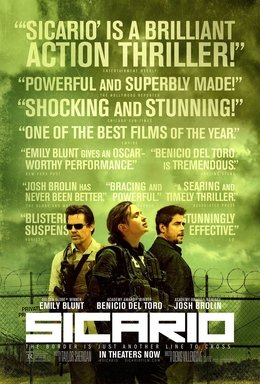
Sicario

Kate Macer (Emily Blunt) works in a police hostage rescue team in an Arizona border town. The film starts with her and a SWAT team attacking a house to rescue some non-existent hostages. But they do find a lot of dead bodies, which they think are killings ordered by a Mexican drug lord. Afterwards she is invited to join a CIA led team that is fighting the drug war at a higher level.

The team, which is mostly composed of Delta Force soldiers, take Kate on their operations including a trip to a very hostile and dangerous Mexico. She is treated as baggage by the guys, especially by Matt Graver (Josh Brolin) who recruited her and the mysterious Alejandro Gillick (Benicio del Toro). She wonders why she was asked to join.

The action is shot in pseudo-realistic way rather than the typical Hollywood action (no leaping cars, no hordes of baddies being mown down with ease). Though there is a very high useful coincidence / "cavalry showing up just in time" quotient.

This isn't a film about a female cop morphing into a crack bad-ass anti-drug gang vigilante. Rather she has trouble coping with what the guys take in their stride. Kate represents us -- law abiding middle class people, who can't hope to fight those bad Mexicans and need the guys who go beyond the law to fight the bad guys for us.

While the film has a dark edge to it. I think it enjoyed itself too much taking a Donald Trump attitude to Mexico, to take it seriously as a critique of the war on drugs There is a parallel secondary story that shows Mexican women and children as innocents, but it feels like an after thought.

Anne thought it felt like the pilot to a TV series and I see on Wikipedia that there is talk of a sequel.

Ian's rating 3/5

Monday, August 17, 2015

The Invitation

Have you ever been the only person in the group who can see what is blatantly obvious? They can't all be stupid, therefore they must be deliberately ignoring it - right?

Will and his new girlfriend attend a party given by his ex- and her new man. It is obvious to Will that this isn't just a dinner party, there is something sinister going on. Each time he raises his concerns they are casually refuted by the hosts or by subsequent events. Obviously Will hasn't fully recovered from collapse of his previous relationship. How will the hosts and other guests react to his increasingly erratic and irrational behaviour? Luckily this group of friends are keen to make this evening a success despite Will.

The Invitation takes place in one evening (supplemented by Will's flashbacks) and, apart from the opening scene, in one location. None of the cast are Hollywood A-listers but they largely play their parts well. My guess is that the budget for this film was low and mainly spent on script writing and rehearsing rather than special effects and exotic locations.

This is a simple and effective thriller with a long slow entree of red herrings, preceded by a little road kill. Just before we die of hunger waiting for it, the main course arrives. It is a hearty, simple dish with a Guyanese influence. Served with dash and full choice of weaponry to deal with it. Nothing subtle here. There is no dessert, just a quick coffee to follow and no left overs for dinner the next day.

Ian's rating 2.5/5