Showing posts with label must see. Show all posts

Friday, August 09, 2019

The Art of Self-Defense

You are an American guy that has been mugged.
A) Do you buy a gun?
B) Do you enrol in a self-defence class?
Casey (Jesse Eisenberg) faces this decision on his voyage of self-improvement and recovery. Option A is represented by a gun shop salesman with a disturbingly honest sales pitch.
The risk of accidental death drastically increases with a gun in the home. … In a violent confrontation, an armed victim is much more likely to be killed than an unarmed victim. Suicide is more common with gun owners too.

You’re really going to love owning a gun.
Option B is a small Karate Dojo with rituals, 11 rules and students ranging from small kids to intimidating macho brown belts.

The Art of Self-Defense is a remarkably dry, dark comedy populated by everyday, normal characters who are completely over the top. For those that like their comedies to have a serious message, this is not one of those films. This is a film of absurd situations and deadpan one-liners, with the best delivered with impeccable timing and seriousness by Alessandro Nivola as Sensei of the Karate Dojo, but even Casey's answerphone gets in on the act "No one else left you a message". Eisenberg's face, mask-like one moment and quivering with emotion the next plays well against Nivola's impenetrable seriousness.


The Art of Self-Defense has been my favourite film of the 2019 film festival so far and the audience reaction in the Embassy suggests that I wasn't the only person to enjoy it.

šŸŽ„

Ian's rating 5/5

Sunday, August 19, 2018

Capharnaüm

Capharnaüm or Capernaum is a confusing title. Merriam Webster defines capharnaum as a confused jumble or a place marked by a disorderly accumulation of objects. While chaos is an apt description of the situations the title really doesn't do justice to this political film about the effect on children of poverty and poor parenting decisions.

Ostensibly Capharnaüm is a courtroom drama as approximately 12-year-old Zain sues his parents in a Lebanese court. But this is just a framing device for telling the story in an extended flashback. The story of a few weeks of Zain's life and family and by extension the story of the bottom rungs of Lebanese society, especially its children. Zain's parents can't remember what year he was born. He has a lot of siblings and being the eldest still at home he feels responsible for the others, especially his 11-year-old sister Sahar. The family lives in a small, dirty apartment owned by a local shopkeeper who has the hots for Sahar and for whom Zain works for as a delivery boy. Zain's mother runs a small-time drug smuggling operation involving the kids, who also sell juice to commuters at rush hour. Zain's father's occupation is not mentioned.

As bad as the initial situation is it gets worse when Zain runs away from home in anger after an unsuccessful attempt to protect Sahar. Eventually, Zain ends up living on the streets trying to look after a refugee toddler when its mother disappears, presumably arrested.
Much of the cast are not previously professional actors and Zain, in particular, who is in almost every scene pulls off an amazing performance. His character's resourcefulness, cynicism, anger and compassion drive the story. While the subject matter is depressing, this is not really a depressing story. Zain's go-with-your-gut instinct approach to life is too much fun to watch. I can only dream of coping with the bad things in life with the aplomb that he does.

Other reviews are divided into those that say that Capharnaüm is too sentimental and emotionally manipulative and those that say it is unsentimental and gritty (and in defence point out that emotional manipulation is at the core of filmmaking). I wonder if the divide is actually between those that were made uncomfortable and wanted to dis the film and its message versus those who accept the dual attack on parents and the system that leads to poverty and refugees. I presume that director Nadine Labaki (who has a bit part in this film and previously started in 2008's Caramel) made this film for a Lebanese audience, a country with 4 million Lebanese and 2 million refugees (mostly from Syria). We are not used to hearing from Lebanese about refugees, which contrasts with the endless reports crisis caused by 1 million Syrian and African refugees arriving in the EU with its population of 500 million.

Ian's rating 5/5 Anne's rating 4/5

Monday, August 13, 2018

The Reports on Sarah and Saleem

We've seen quite a few movies about Palestinians who live in the West Bank (Paradise Now, A Wedding in Ramallah, Omar, Private, The Zoo) but few about Palestinians who are Israeli citizens. So  The Reports on Sarah and Saleem broke some new ground in terms of both that and interaction between Jewish and Arab Israeli citizens.

So in this movie, Sarah is a Jewish Israeli cafe owner, and Saleem is a Palestinian who delivers croissants to her cafe. They move in different circles but they both live in Jerusalem. They both have distracted spouses - Sarah's husband David is an officer in the IDF and is often away and Saleem's wife Bisan is pregnant and is declining sex because it's bad for the baby. So they have motive, proximity and opportunity for the affair they embark on. The bakery van provides a handy venue. You could say their affair was bound to lead to trouble but it seemed harmless enough initially.

The event that really starts the trouble is a late-night trip to Bethlehem. Despite the plan to pretend Sarah is foreign by having her only speak in English, she's rumbled as Jewish and some unhappy Arabs not only give Saleem a hard time, they report him to the authorities, and things escalate from there.

Any affair has potentially troublesome ramifications and I guess the plot revolves around the many ramifications that this affair had, in this politically and racially charged part of the world. Many of them were unexpected, and I was never bored and never knew quite what was going to happen next. This movie is quite woman-centric for a Middle-Eastern film and I liked how Sarah and Bisan didn't just roll over and do what their husbands wanted. I liked how interesting and well-acted some of the lesser characters were - Saleem's lawyer Maryam and the bald Israeli security guy in particular..

Jerusalem looked beautiful as always and the similarities and differences between Jewish and Arab Israelis were nicely highlighted.

Anne's rating 4.5/5 Ian's rating 4.5/5

Friday, August 11, 2017

Bad Genius

Thrillers normally involve threats to life. But the Thai thriller Bad Genius involves issues that are much more relevant to young people. Pressure to succeed, in this case succeed at exams and other pressures from the education system, parents and other students.

Lynn has no trouble with exams but her best friend Grace is not so bright. Not succeeding with tutoring her friend, in a tragedy of miscalculation Lynn resorts to passing answers during an exam. But Grace blabs to her boyfriend Pat and now Lynn has more people wanting her help with exams. As these are students from well heeled backgrounds this proves temptingly lucrative.

As the scam repeats and grows it becomes more complicated and involves an international dimension. Every bit as tense as a more conventional thriller this teen centred film involves threats, cash, blackmail, chases, betrayal and stars four kids whose personalities would be familiar from school.

The wheeling and dealing between the students, the pressure to succeed and the tense atmosphere in the exam room are what drives this film. While it invites us to root for Lynn and her friends to succeed, the film doesn't overlook its duty to deliver a morally correct outcome. šŸŽ„

Ian's rating 4.5/5 Anne's rating 5/5

Thursday, August 03, 2017

Jasper Jones

Jasper Jones is not the protagonist in this film. Bespectacled Charlie Bucktin, who may be 13 but looks 11, the new kid in town, is the protagonist. His best friend is Jeffrey Lu, who is also trying to fit in. The town is Corrigan, Western Australia and the year is 1969. The Vietnam War is on. Prejudice is commonplace. Kids ride around on bikes.

One night Charlie is woken by Jasper Jones the town's half-cast bad boy knocking on his window begging for Charlie's help and for Charlie to come and see something.


While Charlie is anxious, but his strong sense of adventure and righting wrongs trumps this. Jasper's secret quickly puts Charlie offside with his parents, especially his mother (Toni Collette) and with Eliza, a pretty girl who tries to befriend him. It turns out that Jasper's secret is not the only one and Charlie quickly becomes privy to a host of different people's secrets. The subsequent adventures remind me of Enid Blyton's Secret Seven and Famous Five and the friendship with Eliza is like Moonrise Kingdom with some emotion added.

Jasper Jones is a jolly romp and bildungsroman with a dark edge. The acting by the young actors is believable and I felt that I could over look the plot holes and unresolved story lines. It is based on a 2009 novel.

Ian's rating 5/5  Anne's rating 4/5

Monday, August 01, 2016

Land of Mine

Land of Mine dramatises a little-known slice of post-World War 2 history -  German POWs were assigned to clearing mines from the Danish Coast in 1945. This has a sort of poetic justice since it was the German Army that laid the mines if the first place, but if Land of Mine has anything to teach us, it's that war is generally unjust and that it brutalises both sides.

The small group of POWs in Land of Mine are only teenagers and they are scared of their job, and scared of their Danish sergeant. They're billeted on a farm on an achingly beautiful stretch of coast with white sand and turquoise water. The woman farmer is being paid by the Danish Army to feed the troops, but she just pockets the money. So the boys are hungry and the work is dangerous but on the other hand they're outdoors,the weather is ok and they're not being shot at.

 It's hard to explain why a film about clearing mines from Danish beaches is my favourite of the festival so far and why you should see it, especially since a significant number of people do get blown up. I think it's the contrast of youth and and beauty (both the landscape and the soldiers) and age and brutality. And the paradox of the sergeant bawling his charges out for minor misdemeanors (such as apologising) one minute and playing football with them on the beach in another. I can't promise you a happy ending exactly but let's say there are enough acts of human kindness to leave you with a sense of hope.

Anne's rating 4.5/5, Ian's rating 4.5/5

Sunday, August 03, 2014

Timbuktu

This beautiful but harrowing film is a portrait of life in and around the West African city of Timbuktu under militant Islamic control.The Islamic Police prowl the streets and the rooftop armed with machine guns and sometimes with a loud hailer, looking for anyone infringing on their particular brand of religion. Their brand is a joyless and often seemingly pointless one - no football, no music, no hanging out with the opposite sex, women must wear gloves and socks in the market place. Banning cigarettes and alcohol is also included but you can't help thinking that this is because people enjoy their consumption , rather than because they're bad for your health. Their brand is brutal, too - stoning, lashing and shooting seem all in the day's work.

The film focuses on people on both sides of the religious divide. On one side we have Kidane the Tuareg cattle herder, who lives in a tent outside town with his wife and daughter and on the other we have Islamic police themselves - Abdelkrim and his driver get the most screen time. While the police's religious doctrine isn't portrayed sympathetically ( this would be difficult, I think) they are portrayed as human . Abdelkrim's driver kindly tells him he doesn't need to go off and smoke secretly because all his fellow policemen already know he does it.

Kidane has a row with a fisherman neighbour who has killed one of Kidane's cows because it got tangled in his fishing nets. Kidane's gun goes off in the struggle and the fisherman is killed so Kidane ends up in the Islamic Court and things turn out badly.

Before you get too depressed, do remember that this is a beautiful film. Timbuktu is a world heritage site because of its amazing buildings and the surrounding desert is equally beautiful. Living in a Tuareg tent looks particularly romantic but it does make you vulnerable to unexpected visitors. The residents of Timbuktu are  physically attractive, but their  attitudes and lack of automatic acquiescence to their oppressors also make an impression. The Imam of the local mosque gently reproaching members of the police for bringing guns into the mosque while wearing shoes and criticising their theology was memorable and so was a woman explaining (via 2 translators!) that she didn't want her daughter to marry one of them because he was a complete stranger.

This isn't a film you'll forget in a hurry. One of the things I've been thinking about is what motivate religious people who are into harsh punishment regimes for (what westerners would consider) harmless pastimes. Is is because they enjoy the power, or are they motivated by concern for people's immortal souls? And on a less philosophical plane, who was the woman with the chicken and why did the police leave her alone?

Anne's rating 4.5/5    Ian's rating 5/5

Wednesday, October 23, 2013

Gravity

A few weeks ago we discovered that The Roxy Cinema in Miramar has what they call Tuppence Tuesday which means that on Tuesdays it costs a mere $10 to go to a regular movie and $14.50 to go to a 3-D one. Given that parking is free and handy and the decor is fabulous, this is really too good a deal to pass up. So we put in our multifocal one day contact lenses (so we didn't have to put 3D specs over our regular specs), drove to Miramar and bought two of the last three seats, which tells us other people feel the same way.

Gravity is a simple story - three astronauts are working on the outside of the international space station when a bunch of debris comes hurtling through space and kills one of them, damages the space station and separates the remaining two from it. The remaining two are Jack Kowalski (George Clooney) and Dr Ryan Stone (Sandra Bullock) and it's a pleasure to see them being like we expect George Clooney and Sandra Bullock to be (unruffled, charming and slightly self-deprecating in his case and neurotic and a bit clumsy in hers) and yet completely convincing as astronauts marooned in space. I don't mean I forgot I was watching George Clooney and Sandra Bullock, but I was completely absorbed in their plight. This simple story is both gripping and nail biting and most things that can go wrong do go wrong.


Even without the nail-biting action, Gravity is an experience that you shouldn't miss. In the same way that few of us will get to go to Antarctica, even fewer of us will get to go to space. But for 90 minutes, you'll get some idea of what that could be like. The view is sensational, and (literally) out of this world. You'll appreciate the concept of weightlessness and more particularly how there's nothing to slow you (or other things) down once you or they start moving. You'll get the sense of claustrophobia engendered by being in a space suit and breathing a limited supply of oxygen and a sense of how lonely and quiet it is hundreds of kilometres above earth. You'll flinch as space debris seemingly whizzes past your head.

Visually, Gravity is big, beautiful, surreal and spacious. And happily it's emotionally as well as visually satisfying. Movie going as it should be, I think.

Anne's rating: 4.5/5 Ian's rating: 4/5

Sunday, August 11, 2013

The Gatekeepers

Last year there was Ra'anan Alexandrowicz's The Law In These Parts, interviews with Israeli military judges and prosecutors. Much of the evidence against the Palestinians prosecuted and tried by them came from Shin Bet (aka Shabak or GSS). This year Dror Moreh interviews six retired heads of Shin Bet in The Gatekeepers. While the earlier documentary gave us information on how that part of the machinery of the military occupation works, this one gives us a glimpse into another component of that machinery. Dror Moreh says he was inspired by The Fog of War, hence he is less interested in the detail of how Shin Bet works than in the opinions of 6 men who know more about Palestinians than other Israelis and also know more about Israeli actions and decision making from Israeli prime ministers, the IDF, Jewish settlers and terrorists to their own Shin Bet operations.

The six are:
1980-1986 Avraham Shalom
1988-1994 Yaakov Peri
1994-1996 Carmi Gillon
1996-2000 Ami Ayalon
2000-2005 Avi Dichter
2005-2011 Yuval Diskin
Don't expect any major mea culpas. Their job was to prevent Palestinian terrorism against Israel, more accurately frustrate or deter it where possible and to take revenge when desired. Shin Bet's role does not extend to resolving Palestinian issues with Israel. They see their role as preventing Israeli deaths while the politicians solve the political problems. They see any Israeli death as a failure, by that measure they know they did their job well but not perfectly. Avraham Shalom was the most reluctant, but they admitted that Shin Bet was not perfect in a legal or moral sense either. What really annoyed these guys was the failure of Israeli Prime Ministers to solve issues between Israel and Palestinians. In their view from David Ben-Gurion to Yitzhak Shamir, Israeli Prime Ministers did not acknowledge there was an issue to solve and, with the exception of Yitzhak Rabin who made an effort, none since have tried hard enough to resolve the conflict. Since 1967 they see their role as providing safety to Israeli civilians until the politicians came up with a solution. What they didn't see (or perhaps saw but didn't acknowledge) was that Shin Bet's success in keeping a lid on Palestinian frustration allowed successive Israeli governments to do nothing, or worse.

If there is one group of Israelis these guys detested more than their Prime Ministers it is rabbis who incite their congregations. Carmi Gillon in particular, who dealt with the rise of Jewish terrorism and the assassination of Rabin, was particularly bitter over the very early release from prison of most of the Jewish terrorists Shin Bet had uncovered and brought to trial, due to their political and religious connections.

While Ami Ayalon admitted that from a Palestinian point of view he was a terrorist, and while there was an admission that many of the missions were revenge rather than prevention all six were reluctant to admit that there was a circle of revenge Jew against Palestinian against Jew against Palestinian and so on. I presume they didn't want to see themselves as a factor in fuelling the terrorism they were charged with preventing.

At one point there was a brief discussion on the philosophy of terrorism prevention. If you kill or lock up enough terrorists or prospective terrorists then you will eventually reach the bottom of the barrel. You won't get the last few terrorists but they will either be deterred or too few to cause much trouble. This seems to be the Bush-Obama strategy too. Between Jews and Palestinians we've had 130 odd  years and no sign of the bottom of the barrel. Perhaps solving the political issues may be a better approach.

There is some detail on how Shin Bet operates and how that has changed as technology has improved (in particular the use of drones). At the base is detailed background information on an area: maps, building plans, who lives where and who knows who, how society is structured (families, clans, organisations etc). Ongoing information on people's movements, phone tapping and internet monitoring are hinted at but not discussed. More intrusively there are searches, interrogation, and "getting people to tell you what they don't want to tell you" (blackmail, intimidation, torture etc). To find out what a person of interest is up to look at their associates and pick one that is susceptible to being "turned" -- even if you have done nothing wrong you still have plenty to fear from Shin Bet. On top of that there are arrests, imprisonment, torture and assassinations. It is no surprise Palestinians hate Shin Bet more than they hate the IDF. During the occupation of Lebanon, Shin Bet applied the same techniques there and the film boasts that they quickly controlled "everything that went on in Lebanon".
Trailer
Trailer

Ian's rating 5/5

Tuesday, August 06, 2013

Omar

Day two of the festival took me from Saudi Arabia to the West Bank.

Omar, Tarek and Amjad live in the West Bank. Omar is a baker, and he's in love with Tarek's sister Nadja. So far, so ordinary - apart from the feats of athleticism that Omar indulges in to get over the Israeli's security wall to visit his friends. The three men organise the night time shooting of an Israeli soldier -Tarek masterminds,  Omar drives and Amjad shoots. This is where things get less ordinary -when undercover agents come after them, it's Omar that gets caught, tortured and imprisoned. To get out of prison, he undertakes to act as an informant but manages to avoid revealing that Amjad was the assassin. An incredible series of double crosses follows and when the credits roll, the jaws of entire audience were on the floor - not unlike the director's previous film Paradise Now which also takes place in the West Bank. The motivation of the main characters in Paradise Now was religious which contrasts with Omar's more political theme.

Omar and Nadja are beautiful to look at and their habit of writing each other love letters to read when they're apart is completely endearing. In an environment that seems crowded and under constant  surveillance this form of communication seems intensely private.We can't help but be deeply affected by their story

Talking about his film, director Hani Abu-Assad says "At the time I was interested in love stories, particularly tragic love stories, and political thrillers, and I wanted to see if these two genres could merge ". This film is evidence that  they can, and that the merger is totally successful. . The love story is more tragic than Romeo and Juliet's, and the chase scenes would do the Bourne Conspiracy credit. As the characters hurtle through narrow alleys and vault walls, the claustrophobic nature of the West Bank is emphasized. Underlying the whole film is Israel's iron grip on the Palestinian people - it's easy to see which side has the upper hand.

The director says "my job is to let the audience in an entertaining way live in a very difficult situation" . He did his job and you will be more than entertained. Don't miss this one.

Anne's rating 5/5 Ian's rating 5/5


Saturday, August 03, 2013

Antarctica: A Year on Ice


Getting to Antarctica is tricky and expensive and probably most of us won't manage it. All is not lost, however,  because Anthony Powell, a New Zealander who has spent a long time working there, has become fantastically good at time-lapse photography and has kindly made a film so we can  all share in the experience. If you're thinking a documentary about Antarctica sounds worthy and dull, and that you've seen plenty of footage of this kind of thing already, you are just plain wrong. One of the best things about this film is that you get new perspectives on the icy continent.

The film features stunning  time-lapse sequences of weather, ice, sky, the passage of the sun around the sky, the stars and  the Aurora Australis. One of the new perspectives is how much more interesting the winter is than you expect. Although the sun doesn't shine for four months or so, that doesn't mean it's completely dark. There's the moon, the most stunning stars you've ever seen (light pollution being nil) and the amazing auroras.

A Year on Ice's other main facet is  life-in-Antarctica footage and quite a lot of talking heads. It's a  very personal story- Anthony and his wife reveal a lot about themselves and their lives and so do the other workers from McMurdo Base who feature. They are all personable and engaging and their enthusiasm for their location is palpable. They are the source of the new perspectives I gained which include how windy it is, how stinky a penguin colony is and how if you're going to work in the Antarctic and you're hoping to make the most of the scenery you should choose your job carefully.

If you're a fan of nature docos which are mostly just beautiful to look at there's plenty to satisfy you here - and you should be interested to know that Anthony contributed to the Frozen Planet series but saved his best footage for his own film! If you're more into human interest you'll be equally satisfied. If you'd just categorize yourself as a film enthusiast you should come and see what might be one of the few New Zealand documentaries that has wide public appeal and will do well on general release.

Anne's rating 4.5/5

Thursday, August 01, 2013

My Sweet Pepper Land

An independent Kurdistan is one of the more intriguing possibilities that arose out of 20 years of conflict between Iraq and the USA. While that possibility is looking less likely than it did in say 2006, it has produced an autonomous region which in turn has led to Kurds doing things that they wouldn't otherwise be allowed to do. Such as producing feature films.

My Sweet Pepper Land follows our two protagonists as they each run away from family pressure to meet at the end of the earth, namely tiny an Iraqi Kurdish village near the borders with Iran and Turkey. The village has been cut off from the rest of Iraq since Turkish war-planes bombed a bridge 2 hours walk away. The main industries are smuggling alcohol into Iran, guns into Turkey and expired medicines back again all on horse back.


Baran was a hero in the peshmerga during the war and has since found it difficult to adjust to peace. Neither a job as a city police officer nor living with his mother appeal, so he requests a transfer. Meanwhile Govend's horde of brothers want to her to get married, but she wants to return to her teaching job at the remote village school. Both soon clash with the local chieftain Aziz Aga. Aziz Aga doesn't want an independent single woman in the village and neither does he want anyone interfering with his self appointed position as local enforcer and chief smuggler. Baran announces his intention to enforce the law impartially rather than just collect his pay cheque but rethinks this ideal once he meets the women's branch of the PKK.


My Sweet Pepper Land could all too easily be a political film, but the status of women is the only political issue addressed. With a local tough man and his henchmen, a straight-up new-in-town sheriff and a plucky independent woman; with guns, horses and wild countryside; with everyone's honour at stake and a sound track that in places is suspiciously close to Ennio Morricone's in The Good, the Bad and the Ugly we are in no doubt as to the genre. The western is dead in America but it still works in this corner of the world where the rule of law hasn't quite arrived.

Everyone knows what to expect from a western, so we get taken by surprise when My Sweet Pepper Land deviates from our preconceptions of the genre. The seriousness of the subject matter is liberally punctuated by deadpan humour which contrasts with the serious personalities of the protagonists.

Govend's prize possession is her Hang, a modern Swiss musical instrument that features liberally in the soundtrack.

Ian's rating 5/5 Anne's rating 5/5

Saturday, August 18, 2012

The Ambassador

If there is a fine line between serious documentary and comedy then Mads Brügger hasn't found it. Rather he weaves back and forth from wry observation and buffoonary to jaw dropping serious documentary revelations. The Ambassador takes investigative journalism to new territory in film making as Mads takes up the post of Liberia's diplomatic representative in the Central African Republic.

The fact that a Dane is representing one African country in an other, fails to raise an eyebrow in Bengui, is not due to extreme politeness in African culture. Rather it is due to the quaint custom of selling diplomatic posts. The access to government officials coupled with the diplomatic protection that an ambassador or consul has, makes a diplomatic post and passport a valuable commodity to an truly entrepreneurial businessman (or woman). This is especially true in countries where government ministers and officials control the access to valuable commodities such as diamonds, or where you might want to carry small items or large amounts of cash through customs without being searched. Small or poor countries can't afford to send diplomats every other country in the world and in some countries government salaries don't completely meet the lifestyle requirements of government officials. In these cases someone turning up at the right place with the correct amount of cash can purchase a diplomatic passport and accreditation from that country to some other country. Assuming these unpaid diplomats can turn this capital outlay and the access opportunities into a successful business deal or two, it is a win-win situation.

So many of these diplomatic posts and passports are available and so many people want them that there are agencies who act as middlemen and deal with the messy details - for a fee. The Ambassador starts with Mads Brügger approaching two such agencies in search of a suitable passport and credentials. The head of the first of these agencies (a paranoid Brit) bans cellphones and cameras from his meeting with Mads, introducing us to the secret camera work and recording that makes up much of this film. Luckily much of this secret footage is remarkably good and adds to the verisimilitude of the film.

Once armed with a diplomatic passport a slightly foppish "Mr Cortzen" turns up in Bengui as the Honorary Consul for Liberia. Where this "Cinderella of diplomacy" makes contacts with the government, fellow diplomats and other local characters. Some of these are happy to advise or assist the new diplomat in the "do"s and "don't"s of operating in the Central African Republic. This brings up the secondary theme of this film. The interference that foreign governments and foreign companies have over third world countries. The Central African Republic imports a lot of low tech goods that could be manufactured locally, people who have tried to set up factories to manufacture such goods for the local market hit a series of obstacles that eventually bankrupt them. The people that Mads talks to claim these problems are due to outside interference by companies who currently make money out of the status quo. On a larger scale France is accused of interfering at a level varying from not passing on information that might protect the country from military invasion to fomenting coups and murdering people who cross them. This is a subject that is big enough to justify its own separate documentary.

Mads attempts at getting involved in the diamond trade cost him a lot of money in "envelopes of happiness" and illustrate the layers upon layers of people involved in this murky industry. He uses performative journalism, in his own words "instead of disguising as a fly on the wall observing neutrally, I dress for my part and interact as an agent provocateur". This technique gets him a lot closer to his subjects and captures them in their natural environment, in way that traditional journalism almost certainly couldn't.

Ian's rating 5/5

An interview with Mads Brügger.

Friday, August 17, 2012

The Law in These Parts

The most boring documentary format is the studio interview. To keep audience attention the subject being discussed or the people being interviewed must be extraordinarily interesting.

The Law in These Parts opens with a old man unfolding and holding up a poster declaring martial law in Hebrew and Arabic. He tells us this is one of hundreds printed for the IDF years before the Six Day War, in preparation for the possibility that Israel would occupy all or part of an Arab country.

The men interviewed in The Law in These Parts are retired military judges. Some are candid, others are evasive1, some flip-flop. Mostly their answers, while partisan, are refreshingly free of the trite and unconvincing statements that all too often used to justify Israeli actions. The interviews are interleaved to cover the development of Israeli military jurisdiction over Palestinians chronologically from 1967 to 20112.

The film starts with an explanation of what Law means in a military context, its purpose, how it differs from other law, how Israeli military courts function, how military laws are made and changed (at the whim of the Regional Commander, though there are hints that higher command and politicians also get involved) and how the civilian population finds out what the laws are (sometimes by notices and loudspeaker but more often by being arrested by soldiers). The judges pointed out that military law must match International Law, in particular the Geneva Convention. Though they had trouble with justifying blowing up houses and other actions they said were designed dissuading resistance to with the ban on collective punishment and reprisals in the 4th Geneva Convention. The contradiction between the Jewish settlements and Article 49 was also touched on. The film skims over the expansion of the Law to cover everything from putting up posers and throwing stones to cosmetics and accountants, and moves onto some of the landmark cases and their consequences.

One aspect of military occupation that Israelis are quite proud of (and the judges being interviewed were no exception) is that the Israeli Supreme Court functions as the court of appeal for populations under Israeli military rule. It is not clearly explained how and why this came about, but consequences of this form one of the main threads of the documentary. One of the cases appealed to the Israeli Supreme Court in 1979 was of some land confiscated by the IDF for military purposes and handed over to settlers the same day. When the Supreme Court later said that the confiscation was illegal the Minister of Agriculture held a meeting to decide how to get around the ruling. One of the interviewees proudly described how he told the Minister of an Ottoman Law that allowed the Ottoman government to confiscate land more than a cock's crow from a village and that hadn't been farmed for at least 3 years3. The Minister, Ariel Sharon, arranged for a helicopter survey of the West Bank looking for such land.

In cases where the Supreme Court overrules the IDF, unlike its normal swift and decisive manner, can take years to begin to rectify the situation. The film also pointed out that overruling of military decisions by the Supreme Court is rare, normally the Supreme Court finds in favour of the military providing a judicial seal of approval for the IDF's actions.

The aspect of the documentary troubled the interviewees the most and one that they were pressed hardest on was their knowledge of and how they dealt with the torture victims and information gained via torture. Most (but not all) of the judges initially claimed they had no knowledge that torture was taking place. When asked how they dealt with Palestinians detainees who said they had been tortured or looked beaten up, the general response was that if there was a conflict between something a Palestinian said and what the GSS (aka Shin Bet or Shabak) said; they always believed the GSS because Palestinians have a reason to lie!

The judges were also asked how the military law applied to Israeli civilians when they are in the Occupied Territories. The answer is that military law somehow does not apply to Israeli civilians nor to the land they are on when they are in the Occupied Territories. On the other hand (and this was something that troubled some of the judges) it seems that Israeli police and civilian law also does not apply to the activities of Israeli civilians acting against Palestinians - a useful legal black hole for "enterprising" Jewish settlers to exploit4.

The final thing that some of the interviewees mentioned was that they thought that military law is really only a temporary solution. On the other hand they did not offer an alternative - certainly not withdrawing back to Israel.

Despite its unpromising format and unspecific title, The Law in These Parts is a gripping and informative documentary. A must see for anyone interested in law in the wild west.

Ian's rating 5/5


Footnotes:
1. The oldest and most evasive of the interviewees was 86 year old Justice Meir Shamgar Brig.-Gen. (ret) President of the Israel Supreme Court 1983-95 (first appointed to the court in 1975), served in the IDF from 1948 and was previously a member of the Zionist terror organisation Irgun. In 1944 the British send him to a detention camp in Eritrea, where he studied law by a correspondence course with the University of London.

2. It does not cover military rule in the Golan Heights and Sinai after 1967 or in parts of Israel from 1948-1960s.

3. This sounds similar to an Ottoman law used inside Israel to confiscate land from Israeli Arabs.

4. Actually if Israeli civilians cooperate with or defend Palestinians they are liable to be manhandled, shot or arrested (briefly) by the IDF, whereas Israeli civilians acting against Palestinians will be protected by and assisted by the IDF.

Thursday, August 16, 2012

What's in a Name

It's a sad state of affairs when the film festival programme contains only one French comedy - maybe films about policemen are more hip. Maybe nothing else was as funny. Whatever the reason, What's in a Name ticks all the boxes for a great french farce and is definitely one to watch, particularly if you need to have your mind removed from something more tedious.

Claude, Vincent and Pierre


Forty-somethings Elisabeth and Pierre are having a dinner party at their apartment. The guests are Elisabeth's brother Vincent, his pregnant girlfriend Anna, and Claude, a childhood friend of Elisabeth and Vincent. Someone asks what Vincent and Anna are planning to name their baby, and Vincent says the baby will be called Adolphe. This provokes outbursts from everyone present and soon people are saying things they may regret and revealing secrets.Everyone knows everyone very well, and after the dinner party they will know each other slightly better.

The script is witty and fast-paced. There's lots of gesturing and pulling faces. Everyone gets a hard time and no-one's idiosyncrasies are left unexposed . There's not as much physical comedy as some french films but the coffee table does collapse. Your mind is not left to wander and you will laugh. Often. And then you'll pause to ponder the frailty of human relationships.

Anne's rating: 4.5/5 Ian's rating: 5/5 


Saturday, August 11, 2012

The Angel's Share

One of The Angel's Share's claims to fame is that it's directed by Ken Loach, who is famous for gritty films with kitchen sink realism. There's a chance that grit and realism might not be what you're looking for in your evening's entertainment and so this might put you off and I do hope this isn't the case. Like Looking for Eric, (a film we both loved, also directed by Ken Loach),  The Angel's Share mixes grit with humour and charm and a slightly fanciful feel-good story.

Our story is set in Glasgow and features Robbie, a slight but good-looking troubled youth with a pregnant girlfriend who narrowly avoids going to jail at the opening of the film.He leads a somewhat desperate existence, plagued by beatings from some life-long rivals and his girlfriend's relatives who are less than keen on  the relationship. He's sentenced to community service and so makes the acquaintance of Harry the supervisor and Rhino, Albert and Mo, who are similarly troubled youths.


Harry gives Robbie a ride to the hospital when his son is born and then takes him home for a celebratory whisky afterwards. Robbie's appreciation of the subtleties of whisky inspire Harry to take him (and in fact the rest of the community service crew) to a  distillery and later to a formal whisky tasting. Robbie comes up with a cunning plan to steal some of a very rare single malt from an isolated distillery and  sell it to solve his financial woes. He conscripts Rhino, Albert and Mo to help him and the next part of the film is reminiscent of a Famous Five adventure with Scottish accents - it only lacks Timmy the dog. This is not a criticism - this is all rollicking good fun although the jolly life-affirming stuff is tempered with doses of violence.

You'll have to concentrate to make sure you catch all the dialogue which is delivered with broad Scottish accents and you'll have to be comfortable with plenty of four letter words but it's all worthwhile and the happy ending is most satisfactory

Anne's rating 4.5/5 Ian's rating 4/5

Monday, August 06, 2012

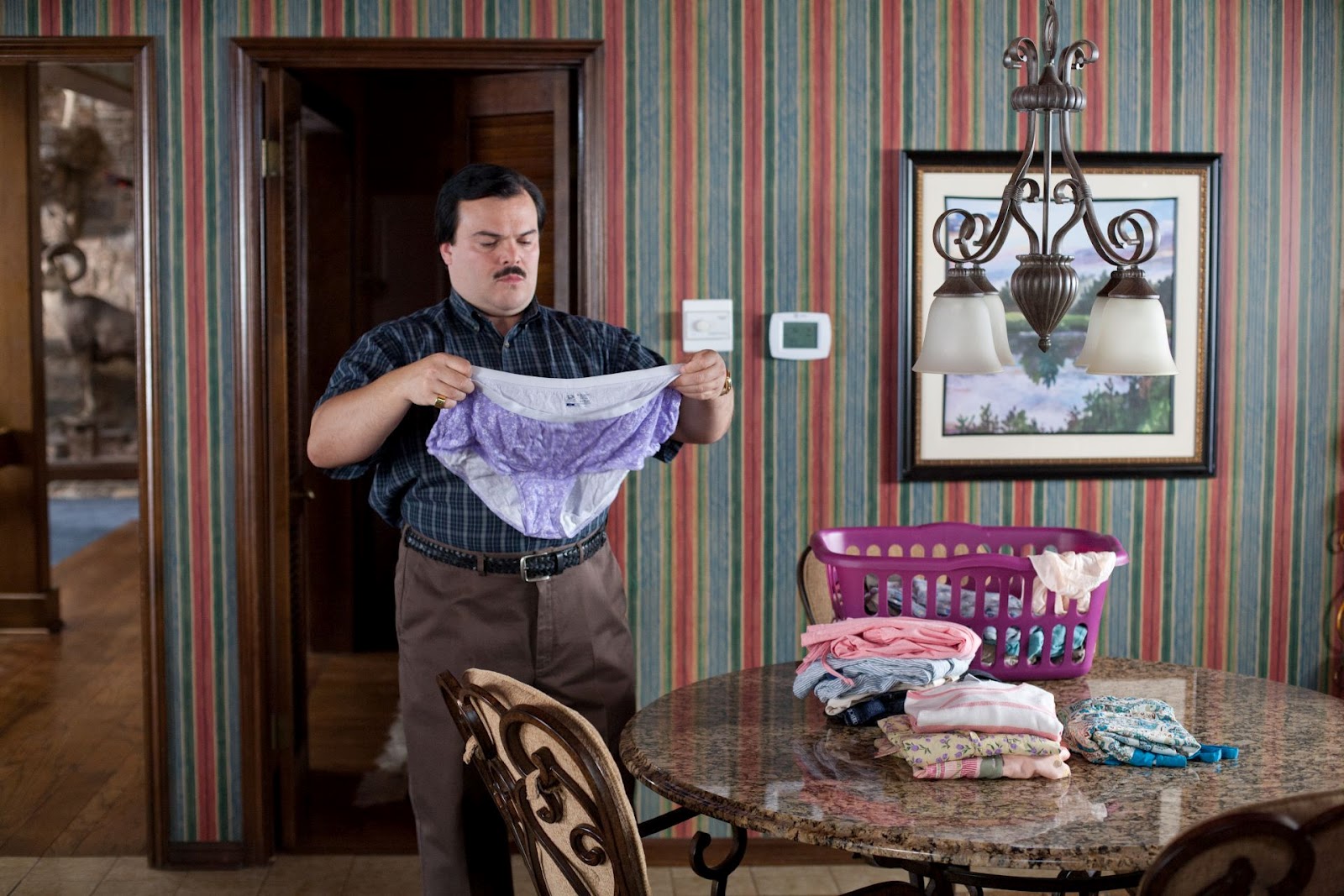
Bernie

Bernie is an incredible tale, which actually took place in small-town Texas in the 1990's, Bernie Tiede was the assistant funeral director in Carthage, Texas and, by all accounts was a particularly nice guy- considerate, generous and friendly. He was good at his job and good with people, especially with older women. He was a good singer and very involved with the commuunity.  In his thirties he became the live-in companion of a rich widow in her late seventies named, Marjorie Nugent,  who was almost universally described by Carthage residents as "mean".

Marjorie and Bernie travelled the world in considerable style and Majorie gave Bernie power ofattorney over her affairs. Power of attorney was the upside, the downside was that Majorie was difficult, demanding and kept Bernie on a very short leash. One day in 1996 Bernie shot Majorie, presumably out of frustration, and put her body in the deep freeze, and he wasn't found out for nine whole months. Once he was found out, very few of the residents of Carthage thought he'd actually done it, and if they did think he'd done it they didn't think he should go to jail.


Bernie the movie is cleverly structured.The re-enactment of the story is interspersed with talking heads interviews with real-life Carthage residents and with Matthew McConaughey playing the District Attorney Danny Buck. These interviews give a kind of gossipy flavour to an already incredible and gossip-worthy story which helps build the atmosphere of the film. Jack Black's great acting as Bernie helps build it further.

On one level, this is an amazing story which was well worth telling in its own right. On another level there is a whole raft of philosophical and moral questions to occupy your mind further. Is murder ok if you're provoked? Should really nice guys go to jail? If God can forgive murderers, should we do that too? Was Bernie a scheming gold-digger or did he just have a really bad day?

Once you've watched Bernie you'll feel like you need to pick your jaw up off the floor but you'll also feel like you got to know a bunch of Texans and that you've thought about some things you don't usually think about. Well worth the effort.

Anne's rating:: 4/5. Ian's Rating: 5/5


Monday, August 22, 2011

Incendies

Incendies was one of the two films I was disappointed to miss during the Film Festival. Luckily I got to see it at the Brooklyn Penthouse four days later. In summary, if I had seen it during the festival I would have classed it as the best film of the festival.

Incendies is an adaptation of Wajdi Mouawad's play about twins (brother and sister) who have to unravel the mysteries of their dead mother's life. Often plays adapted into movies give away their origins by having a small cast, a limit number of locations, very little action and depend on dialogue to move the plot forward. But unlike many adaptations of plays this one hides its roots very well.

Twins Jeanne and Simon Marwan have opposing ideas on whether their mother was crazy. At the reading of her will Simon begins to think that his mother's Notary and long time employer, Jean Lebel, is equally crazy. Simon wants to embrace his North American upbringing and forget his Lebanese heritage (and associated baggage that created the crazy mother who brought him up). The will includes 3 odd requests from his mother. While Simon washes his hands of his mother, Jeanne takes on the mission set by their mother and flies to Lebanon.

Phrase book in hand Jeanne tries to track down mum's family. The film flashes back from time to time into their mother's recent and distant past. So we find out the back story slightly ahead of Jeanne. Jeanne and her mother, Nawal, look similar and so it pays to concentrate to verify whether the young woman is Jeanne or Nawal in flashback. That the young Nawal was involved in a war generally gives it away. Eventually Jean Lebel brings the reluctant Simon to join Jeanne in Lebanon to wrap up the mission and make sure they are both on hand when the final secret is revealed.

This is a mystery story that starts very slowly, but gradually the pace picks up as you (and the twins) get to know more of the back story and find out that they didn't know their mum at all. Eventually the mystery unfolds to a suitably dramatic climax. At the end you realise that the Quebecois Notary knew a lot more than he originally let on.

While Canada is mentioned a lot in the film, Lebanon is not mentioned once, but what other Arab country has a power struggle and civil war between Muslims and Christians? Where French is commonly spoken, there a powerful enemy to the south and Palestinian refugees? What is the taboo about mentioning Lebanon (or Israel for that matter)? Is the idea to make the war, the politics and the atrocities more abstract by not mentioning their location? But given that the Muslim versus Christian conflict is openly discussed, this is not an abstract civil war but clearly one where religion is used to identify factions. My guess is that they were trying to avoid upsetting some people, by in effect saying "you may think this is Lebanon and those planes are from Israel but we refuse to confirm or deny that". That said they don't flinch from the horrors of war and what passes for 'peace' in Lebanon.

Incendies is sometimes translated as Scorched.

Ian's rating 5/5

Thursday, August 11, 2011

Point Blank

Be warned, Hollywood will remake Point Blank and people will tell you that you should have seen the original French version. The premise is simple enough: a wanted man is in hospital, people want him out before he can talk to the cops so they kidnap a trainee nurse's wife and blackmail him into smuggling the man out of hospital.

The presentation of the story is signalled by the opening scene of a wounded man running. Pain and speed are two of the main themes in this thriller. The gangsters, the police and our hero, Samuel, race through Paris day and night, above and below ground, mostly on foot. Almost all the surviving players are wounded by the end of the film. Point Blank is also characterised by sudden plot twists that come at you out of nowhere and throw your conceptions of what is happening out the window. It is an edge of your seat thriller that doesn't let up until the final scene.

Like most thrillers there are a couple of spots where implausible things happen but the pace of the film is so fast that you'll forget instantly what they were. It is nice to see the cops using nothing more sophisticated than cellphones and close-circuit TV. One thing Hollywood won't be able to reproduce is the gritty, unattractive looking French cops. As Hugo points out when Samuel asks:
Why can't I be the cop?

You're too good looking.
Samuel is the centre of this film. He is no superhero, though he can run and usually pick correctly who to trust. No mean feat given all those stairs and the double crossing going on.

Ian's rating 5/5

Saturday, August 06, 2011

The Trip

As its name implies, The Trip is a road trip movie, and it's done really, really well. I discovered after I started writing this blog that it's actually a condensed version of a 6 part BBC TV series of the same name - so I'm not sure if we or the TV audience got the best of the deal. British Comedians Steve Coogan and Rob Brydon go on a gastronomic trip around Lancashire, Cumbria and Yorkshire, purportedly because Steve Coogan's girlfriend dropped out at short notice.

This premise provides layers and layers of entertainment potential. Firstly, the scenery is great, and since we went to most their destinations 20 years ago it had the pleasure of the revisiting old haunts. In particular, Malham Cove in Yorkshire is just as spectacular as I remember.

Secondly, it puts two very funny people together to amuse us. Lots of time is spent in idle banter, competitive impersonation of other actors, making puns and singing. It's just fun to be tagging along.

Thirdly, there's an interesting investigation of Rob and Steve's friendship, with a clever contrasting of their personal lives and personalities. Steve is portrayed as sexier but more troubled - the bigger woman magnet and the one with the broken marriage. Rob is portrayed as the devoted new dad with a loving wife waiting at home. Their relationship is portrayed as superficial and competitive, but as the film unfolds it seems that genuine affection and enjoyment of each other's company emerges. An insight into how much this is fact or fiction appears in a Guardian Article if you want to know more.

Fourthly, there's a background of gourmet food - I thought this was going to part of the comedy, a sort of piss-take on pretentiousness but this wasn't the case. Maybe the food was a bigger part of the TV series.

And fifthly, there's a kind of celebration of Englishness - epitomised, I thought, by Steve Coogan's parents - cups of tea, an enthusiastic dissertation on the best route from A to B and a dismissal of Steve as being not as funny as his siblings.

The Trip is laugh-out-loud funny and I think you should go.

Anne's rating 5/5. Ian's rating 3/5.