Tuesday, August 20, 2013

What Maisie Knew

They say you can't choose your relatives, and if you were Maisie, the charming six-year-old at the centre of this movie, you wouldn't have chosen the parents she had. A possible alternative title for the film could have been How Not To Be a Parent. At the beginning of the film, Maisie's parents  (Suzanna the rock singer and Beale the art dealer) separate. They each fight for sole custody, but the judge comes down in favour of a shared solution. It's not clear whether each parent fought for custody to get one over on their ex or because that's what they thought a parent should do, but one suspects it was more the former than the latter. While they each appear to have affection for their child they have no desire to let looking after her interfere with their respective careers or lifestyle.

Beale solves the problem of child minding by promptly marrying Margo, the family's Scottish au pair who Maisie is already fond of. Suzanna follows suit by marrying Lincoln, an easy-going bartender. I'm sure she chose him for his good looks and temperament but it turns out he's great with kids. So then we see these train-wrecks of parents stuffing up their new relationships and completely failing to ensure Maisie's well-being. One of the most heart-wrenching scenes is Maisie being put out of a taxi by her Mother outside the bar where Lincoln works and when she gets inside we discover Lincoln isn't working that night.

So I'm sure you're wondering why you'd put yourself through watching something quite so traumatic and it's hard to encapsulate why it's such a rewarding watch. It's partly because its very much from Maisie's perspective and  very non-judgemental - we see the characters' behaviour and can form our own conclusions. It's also because the young actor who plays Maisie does such a good job. Iit's because even though she has such useless parents there are still people who care for her and look after her well and with whom she forms relationships - and it's a refreshing change for the step-parents to come out looking like the good guys.

Alexander Skarsgard (who plays Lincoln) is a ravishing as ever, and a totally appealing character to boot. You can't blame Margo for finding him more rewarding to spend time with than her monumentally selfish husband  (Steve Coogan, who's very practiced at playing bastards). As the film draws to a close, there's hope for a happier future for Maisie and the good guys.

Anne's rating 4/5.

Watch Trailer


Sunday, August 18, 2013

Hannah Arendt

Hannah Arendt is named for its subject, a German-Jewish philosopher, lecturer and author who lived in New York from 1941 until she died in 1971. The film covers her being sent to Jerusalem to cover the trial of Adolf Eichmann  (the SS officer who was in charge of the logistics of the deportation of  Jews in Eastern Europe to concentration camps) by the New Yorker magazine in 1961 and it covers the personal fallout caused by what she wrote.

There's no shortage of this kind of biographical drama on film. Erin Brockovich springs to mind. So does The Queen. To work well, the life portrayed should be remarkable in some way. It's helpful but not essential if the life portrayed is inspirational or uplifting. Giving an insight into a particular place and time is also helpful.

Hannah Arendt meets these criteria. This particular incident in her life was remarkable because she looked at someone involved in mass murder and didn't see a monster but an ordinary man who did a job. She coined the phrase the banality of evil to describe him doing that job. She wrote about what she saw and thought and was unrepentant when an avalanche of criticism came her way. Her personal resolve and unwavering conviction is inspirational to an extent  - though it's always hard to know if this shows strength of character or pigheadedness. We do get insights - into her marriage (which seemed particularly caring) , her apartment (huge with a view of the river),  her social circle (who seemed communicative, thoughtful and considerate) and into the reaction of the Jewish community at large to her views on Eichmann and the role of Jewish leaders in the efficient deportation of Jews The fact that she herself was Jewish added an extra level of interest.

I felt that the subject of the nature of evil only got as much coverage as was necessary to move the narrative along which was a pity.  I guess if a biographical drama inspires you to read more about the person it portrays or to read their works (listen to their music, or look at their art) then it has done its job, as long as you weren't bored while it was doing it. I wasn't bored but feel I could have been more stimulated.

Anne's rating 2.5/5

Saturday, August 17, 2013

The Gilded Cage

It's hard to write a review of The Gilded Cage without damning it with faint praise. While it was a perfectly satisfactory entertainment experience I can't help comparing it unfavourably with other more compelling French comedies.
Maria and Jose are well-assimilated Portuguese immigrants who have lived in Paris for the last thirty years. and their children were born in France.They're the caretakers of an apartment building and they live on site. Caretaking is Maria's full-time job whereas Jose is the foreman for a construction firm. Jose's estranged brother dies and leaves them the family home and business in Portugal on the proviso that they reside there. The dilemma they face is that having spent the last thirty years working hard and looking after other people they're not sure they'll be comfortable just looking after themselves. And having grown up in France, their children are not that keen to come.

Initially, Jose and Maria keep the news of their inheritance to themselves but Maria's sister reads the solicitor's letter when she's visiting and tells everyone she can think of  - in strict confidence, of course. So the residents of the apartment building and Jose's boss exert themselves to try and make Jose and Maria stay in Paris, which is all very self-centred of them. The other major plot strand is that Jose and Maria's daughter is dating/bonking  Jose's bosses son. In seems that the daughter of a Portuguese immigrant should not be consorting with a businessman's son ( read have a relationship outside their own social class and possibly also ethnic group) and they've gone to great lengths to keep the relationship secret.

The plot is really the downfall of the movie. To a New Zealand audience at least, the class difference aspect seems desperately old-fashioned and Jose and Maria's dilemma seems a bit of a no-brainer, so the drama is not that gripping. On the other hand, the plot isn't silly enough and the conspiracy of the friends and residents not funny enough for it to be one of the splendid farces that the French are so good at. That said the main characters are quite likeable, the film is amusing and there's a most satisfactory happy ending. It's a kind of celebration of the people in everyday life - family, friends, neighbours and co-workers and how they contribute to quality of your existence.

Anne's rating 2.5/5, Ian's rating 3/5.

Giselle

Having meant to go and see the New Zealand Ballet perform Giselle when it was staged last year and somehow missing it, an opportunity to see the performance on screen instead seemed worth seizing. And the screen being the big one at the Embassy theatre made it even better. There was definitely a sense of occasion - the opening music gave me goosebumps.

The ballet has a somewhat bizarre plot which you can read about here. Suffice to say it's a rather tragic love story with the second act taking place at night which makes it very atmospheric.  Giselle is played by Gillian Murphy (a principal with American Ballet) and Qi Huan, a Chinese-born member of the New Zealand ballet, plays Albrecht. The performance is a  particularly good one and the chemistry between the two leads is  palpable.


While this is a film of a performance with a better view than you'd get if you were in the theatre, you also get some "special features" - like watching the DVD rather than going to cinema. We see Gillian and Qi rehearsing the second act pas-de-deux in the studio in plain clothes which allows you  to see that the chemistry isn't restricted to stage performances and that the dancing is just as awesome without the costumes, the scenery and the rest of the cast. We also see them separately in New York and Shanghai, and then together in the Catskill Mountains near in New York. If you thought redheads shouldn't wear red, you should see this film! Unlike many of the special features on a DVD,  the ones in this film really add to the experience of watching the film, and make you conscious of how good a job principals do of portraying a love story.


The costumes and scenery are both beautiful and atmospheric. The dancing is astounding at times- and not just by the two principals. As an experience it's thoroughly rewarding and if you don't feel like the whole film, do watch the trailer which gives you a bit of everything, including the red dress.

Anne's rating 4/5.

Wednesday, August 14, 2013

Like Father Like Son

Like Father like Son has the same premise as The Other Son . Two babies get swapped in the maternity hospital and brought up by people who are not their parents. The mistake gets discovered at some point and the families have to deal with the fallout. In The Other Son we're in Israel, the babies are now eighteen, one is about to join the army and has a blood test which shows that his blood type is incompatible with that of his "parents". In Like Father Like Son, we're in Japan, the babies (also boys) are just turning six and the process of enrolling to go to primary school involves blood tests and the same scenario plays out - two sets of parents are summonsed to the hospital for an interview to get the shocking news.While the basic plot seemed very similar I thought it would be interesting to see how the subject was treated in a different country by a different director.

 Keita, a sensitive and eager-to-please only child, has been raised by Ryota, (a business man who is very focused on work)  and Midori, who does most of the hands-on parenting. They live in an apartment in a multi-story building in the city.
 Ryusei has been raised by Yudai and Yukari. Yudai is an appliance repairman  an and his family live over the shop in the suburbs. Ryusei is the oldest of three children, who worship their Dad because he is so much fun.

The Hospital's  lawyer says that in 100% of such cases the children are eventually swapped and brought up by their biological  parents. The parents seem to find this fact particularly compelling and start a programme of weekend child swapping, moving on to a complete swap fairly promptly - with the idea that it's good to make a complete break. Of course this is a recipe for everyone being miserable and missing their parents/home/child a lot so the end of the film sees an impromptu visit and the promise of a "best of both worlds approach.

Whereas the Other Son's particular focus was genetic identity and ethnicity, Like Father like Son is more an examination of relationships - fatherhood in particular. What if your son prefers the other father because he's more fun? Is your son better off with the other parents because they're wealthier? Should you deprive your son of his brothers and sisters? Should Mothers have an instinct for recognising their own baby? Should you try and emulate your own father's parenting style.

Like Father like Son is a gentle, absorbing film. Ryota's journey of self-discovery as a father is very moving and the child actors provoke a great deal of empathy.

Anne's rating 3.5/5

Tuesday, August 13, 2013

You're Next

A slasher fest is where a group of people go to an isolated, creepy location and get killed one by one in a variety of gory ways. The audience gets to be shocked by the sudden appearances of the killer (out of the dark, through the window, from behind the victim, when the victim goes through a door, when the victim is sans clothes, etc.) They get to enjoy the gore, and to speculate on who will be the next victim and which characters will survive to the final credits.

When I get the New Zealand International Film Festival program one of the first things I do is flip to the back to checkout Ant Timpson's Incredibly Strange section. This is a mix of horror films and other odd ball films that don't fit in other sections. This year the Incredibly Strange section included Blue Ruin which is a perfectly respectable small thriller that feels like it was miss filed and should have been in the same section as The East. You're Next on the other hand is typical Ant Timpson material.

You're Next is a slasher fest which starts with the first two victims being killed during the opening credits and before the main group begins to arrive for a family re-union at the big old house down the road.

The general air of doom seems misplaced as the family get down to sniping and bitching. But we know the calm won't last, and the next death is a relief from unpleasantness of the passive-aggressive brotherly feuding. At 10 people the group is unusually large for a slasher film, and you wonder if they will run out of imaginative ways to kill them off. But we are in safe hands and the typical suicidal strategies take over.


There are plenty of shocks both sudden and bloody, interspersed with plenty of laughs and at least four good plot twists. Be warned that there is no shortage of gore as a wide variety of household objects are put to use beyond their manufacturer's specifications.
Trailer
Trailer

Ian's rating 4/5

Much Ado About Nothing

Last year I complained that Joss Whedon had short changed Amy Acker in The Cabin in the Woods. This year he has made it up to her by giving her the role of Beatrice in his Much Ado About Nothing. She is more convincing with her jibes about love and about Benedick than he is in return. But Alexis Denisof (Wesley Wyndam-Pryce from Buffy and Angel) has the edge over her when it comes to being silly, especially the physically comedy in the hiding scene.

Shakespeare often puts in pantomime comedy scenes with buffoon characters. Chief buffoon in Much Ado About Nothing is Nathan Fillion as Dogberry (head of the night watch) who steals all the scenes he's in. It is a pity Shakespeare made the part of Don John (the Bastard Prince) is so small because cupcake thieving Sean Maher looks perfect as the evil schemer with Riki Lindhome, showing plenty of leg, as Conrade his sulky girlfriend.

The story goes that Joss Whedon likes to host play reading evenings for his actor friends. So as a wedding anniversary gift to himself he decided to one step further and film Shakespeare's Much Ado About Nothing in his house, using his actor friends on the cheap. While the script is straight up Shakespeare, the setting is a Californian house party with the men in suits and the music provided by Ipods.


Initially the modern setting makes Shakespeare's language sound alien, but you quickly get used to it and find the familiar setting make it easier to understand what he was trying to say. I can see this film being used to make Much Ado About Nothing more understandable to today's school kids. Though Dogberry and his fellow watchmen seem over the top in a modern setting. There are minor changes to Shakespeare's original script, Antonio has been dropped and Conrad is now a woman.

On the other hand I don't understand the reasons for filming in black and white.
Trailer
Trailer

Ian's rating 3.5/5

Sunday, August 11, 2013

Fantail

Tania is a Maori, a blue eyed blonde Maori. She works the night shift at a South Auckland petrol station run by Rog and looks after her sick mother during the day. She and her younger brother Pi are saving money for a trip to Surfers to visit their dad and the fun parks there. While Tania has the "work ethic" Pi goes to pick kiwifruit in Te Puke but finds work too boring. Back in South Auckland a new regional manager, Dean, has shown up, and keeps showing up. Dean is a little too full of himself and provides most of the comedy moments in the film. For instance: trying to teach Tania how to smile at customers and the V drinking dare.

Fantail is a New Zealand film, so it is not all laughs on the night shift. There has to be a dark side. Even though it was well signalled in retrospect, judging from the comments during the Q & A afterwards, most of us were taken by surprise. Hats off to writer / actor Sophie Henderson and first time film director Curtis Vowell for a well executed twist.


Fantail was funded by the New Zealand Film Commission's Escalator scheme for feature films with a budget of up to $250,000. This isn't a big, flashy film, nor is it a high-brow art house film, but it makes you laugh and think and deserves to be seen by a wider audience than a single showing in each main centre.
Trailer
Trailer

Ian's rating 3.5/5 Anne's rating 4.5/5

The Selfish Giant

I read the film festival programme, I rate things Id like to see, I see whether you I can timetable them, I buy some tickets and generally I have an entertaining and stimulating time going to watch films. Sometimes, however, I get it horribly wrong. Going to The Selfish Giant was one of those times.

I arrived at the Paramount to find I was in row M, which as Ian has already said is "unsuitable for people with legs" and this didn't bode well. The film turned out to be a much bigger problem than the seat. Five minutes in, I considered whether to go home but some masochistic or thrifty impulses prevented me.

So what was so terrible? The Selfish Giant is 93 minutes of all the characters being almost unrelentingly unpleasant to each other for no good reason. The main characters are two teenage boys, Arbor and Swifty and they are both unappealing. Arbor has ADHD and is as foul-mouthed as his parents and the only time I warmed to him was when he hugged his mother to comfort her. Swifty is slightly less obnoxious ( he's kind to horses)  but he gets killed off. The setting is industrial and grim and poor in a way the British can do so well.

I can hear you say "lots of films are about characters being unpleasant to each other" and that's true. Usually there's some point to it, or something uplifting comes from it and with this film this just not the case. The film festival programme says "exciting, tough and superbly acted" but I say "stay away". This is my first zero-rated film on this blog because cleaning the oven would really have been more fun than watching this. And cleaning the oven usually provides a sense of satisfaction.

Anne's rating 0/5

The Village at the End of the World

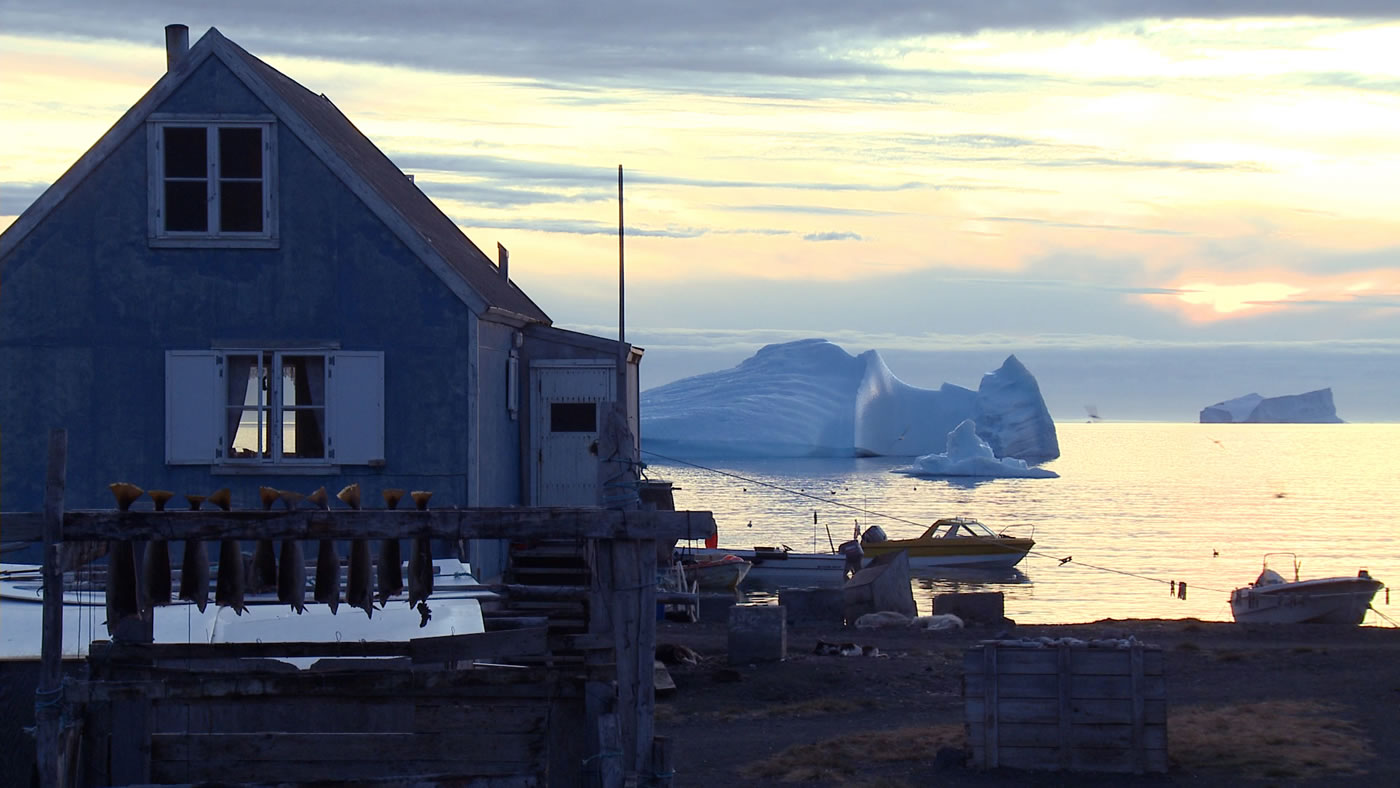
This film festival has been excellent for seeing exotic places - Saudi Arabia, The West Bank, Antarctica, Kurdistan, Japan - and The Village at the End of the World took me to Greenland. Like Antarctica: A year on Ice, this documentary also spanned a year. - in this case of the lives of the residents of Niaqornat, a  tiny village on the western coast of Greenland.

We gets to grips with living in an isolated community - the only way in or out for most people is by helicopter and goods come by boat , but only from May to December. Towards the end of winter, hunting is a viable way of feeding the village. There aren't many jobs - since the Royal Greenland Company closed the fish factory  in 2008 people fish or hunt, there's one school teacher, one village administrator, one person runs the shop (the only teenager helps out) and one excrement collector - you could call him a nightsoil collector, except that he works during the daytime. The economics of the community and their quest to resurrect the fish factory is a big part of the film.

The landscape and the scenery are another big part. In the winter, the sea freezes but even in the summer there are icebergs floating in the bay - so the view is always changing. The lack of things growing really struck me - there are no trees and no-one in Niaqornat has a garden. We see a bit of moss and grass on the hills. Vegetables are things that are brought in by boat, and one of the older residents said he didn't really like them since they weren't a part of the traditional Greenlandic diet!
 I'm sure there's many plenty of fodder there for more documentaries - one on sewage and waste disposal in Arctic environments, for example. And whether the many dogs were using for sledding or as pets.However, you can start with the one on offer, Getting to know Niaqornat and its people makes for a very pleasant eighty minutes and expands your world view.

Anne's rating 3/5.

It Boy

Alice, the workaholic, perfectionist editor for trendy Rebelle magazine is anxious that her job is under threat from a younger, more outrageous Lise who has Alice's boss twisted around her little finger. Office gossip over a tweeted cellphone photo adds to her woes, until a friend points out how to spin the situation to change her no-fun image. What starts as office one-upwomanship morphs into a typical romantic comedy of boy meets woman, boy loses woman, woman finds boy, woman screws things up, boy sulks, woman finds boy again.

Alice is twice Balthazar's age and used to being hit on and swatting away men on a daily basis. Balthazar is gawky, well meaning and photogenic (Anne says cute), but without the X-factor implied by the English title - It Boy. Alice starts cool and sophisticated to match her perfectionist corporate image, but lets her hair down (literally) and turns into a man boy eating sex kitten.


The English title is odd, I overheard the film being called IT Boy (as in Information Technology) in the foyer of the Penthouse. Rachel put me on the right track, it is a play on It Girl. A surprisingly old concept (popularised by the 1927 film It). The French title 20 ans d’écart, which translates as "20 years apart", is more obvious.

Despite the centrality of the age difference the film doesn't explore it too much. Even Alice's daughter is down played. In fact the real age difference between leads is only 12 years and looks less. It doesn't pay to think too much about the plot and luckily the pacing doesn't give you much time to think. Just enjoy the comedy, especially the sex scene involving Angela Merkal and François Hollande. There are some good supporting characters, in particular Alice's matchmaking sister and Balthazar's motor racing father (who is dating one of Balthazar's class mates - making Alice and Balthazar look like a well matched couple).

Trailer
Trailer
I wonder if the message for women is -- try a boy, you might like it.

Ian's rating 4/5 Anne's rating 3.5/5

The Gatekeepers

Last year there was Ra'anan Alexandrowicz's The Law In These Parts, interviews with Israeli military judges and prosecutors. Much of the evidence against the Palestinians prosecuted and tried by them came from Shin Bet (aka Shabak or GSS). This year Dror Moreh interviews six retired heads of Shin Bet in The Gatekeepers. While the earlier documentary gave us information on how that part of the machinery of the military occupation works, this one gives us a glimpse into another component of that machinery. Dror Moreh says he was inspired by The Fog of War, hence he is less interested in the detail of how Shin Bet works than in the opinions of 6 men who know more about Palestinians than other Israelis and also know more about Israeli actions and decision making from Israeli prime ministers, the IDF, Jewish settlers and terrorists to their own Shin Bet operations.

The six are:
1980-1986 Avraham Shalom
1988-1994 Yaakov Peri
1994-1996 Carmi Gillon
1996-2000 Ami Ayalon
2000-2005 Avi Dichter
2005-2011 Yuval Diskin
Don't expect any major mea culpas. Their job was to prevent Palestinian terrorism against Israel, more accurately frustrate or deter it where possible and to take revenge when desired. Shin Bet's role does not extend to resolving Palestinian issues with Israel. They see their role as preventing Israeli deaths while the politicians solve the political problems. They see any Israeli death as a failure, by that measure they know they did their job well but not perfectly. Avraham Shalom was the most reluctant, but they admitted that Shin Bet was not perfect in a legal or moral sense either. What really annoyed these guys was the failure of Israeli Prime Ministers to solve issues between Israel and Palestinians. In their view from David Ben-Gurion to Yitzhak Shamir, Israeli Prime Ministers did not acknowledge there was an issue to solve and, with the exception of Yitzhak Rabin who made an effort, none since have tried hard enough to resolve the conflict. Since 1967 they see their role as providing safety to Israeli civilians until the politicians came up with a solution. What they didn't see (or perhaps saw but didn't acknowledge) was that Shin Bet's success in keeping a lid on Palestinian frustration allowed successive Israeli governments to do nothing, or worse.

If there is one group of Israelis these guys detested more than their Prime Ministers it is rabbis who incite their congregations. Carmi Gillon in particular, who dealt with the rise of Jewish terrorism and the assassination of Rabin, was particularly bitter over the very early release from prison of most of the Jewish terrorists Shin Bet had uncovered and brought to trial, due to their political and religious connections.

While Ami Ayalon admitted that from a Palestinian point of view he was a terrorist, and while there was an admission that many of the missions were revenge rather than prevention all six were reluctant to admit that there was a circle of revenge Jew against Palestinian against Jew against Palestinian and so on. I presume they didn't want to see themselves as a factor in fuelling the terrorism they were charged with preventing.

At one point there was a brief discussion on the philosophy of terrorism prevention. If you kill or lock up enough terrorists or prospective terrorists then you will eventually reach the bottom of the barrel. You won't get the last few terrorists but they will either be deterred or too few to cause much trouble. This seems to be the Bush-Obama strategy too. Between Jews and Palestinians we've had 130 odd  years and no sign of the bottom of the barrel. Perhaps solving the political issues may be a better approach.

There is some detail on how Shin Bet operates and how that has changed as technology has improved (in particular the use of drones). At the base is detailed background information on an area: maps, building plans, who lives where and who knows who, how society is structured (families, clans, organisations etc). Ongoing information on people's movements, phone tapping and internet monitoring are hinted at but not discussed. More intrusively there are searches, interrogation, and "getting people to tell you what they don't want to tell you" (blackmail, intimidation, torture etc). To find out what a person of interest is up to look at their associates and pick one that is susceptible to being "turned" -- even if you have done nothing wrong you still have plenty to fear from Shin Bet. On top of that there are arrests, imprisonment, torture and assassinations. It is no surprise Palestinians hate Shin Bet more than they hate the IDF. During the occupation of Lebanon, Shin Bet applied the same techniques there and the film boasts that they quickly controlled "everything that went on in Lebanon".
Trailer
Trailer

Ian's rating 5/5

Saturday, August 10, 2013

The Wolverine

Why, you ask, does the Wolverine get a review in the middle of the film festival? The answer is that the draw of a free ticket is quite strong. Coopervision, who make contact lenses, shouted a bunch of optometrists and their staff/hangers-on a private showing of Wolverine. There was food and drink. And as it happened we didn't have any other movies booked that night.

Wolverine is a Marvel comic book superhero. His special power seems to be that he sprouts long metal spikes from one hand and short curved metal claws from the other when he's enraged. He's immortal, which as watchers of vampire movies will know tends to have a bad effect on the personality. Wolverine's personality has been further marred by the fact that once upon a time he had to kill his wife.

The Wolverine  opens in Nagasaki in 1945. Wolverine (aka Logan)  has been  imprisoned in a well shaft  in a POW camp. Along with one of the Japanese Officers, he shelters in the well shaft  when the atomic bomb  is dropped and escapes the worst of the fallout. The Japanese officer is grateful that Wolverine saved his life by persuading him in there.

Fast forward to 2012 (or thereabouts). The Japanese officer (Yashida) is now the head of a big corporation and wishes to express his gratitude and say goodbye to Logan before he dies. He sends Yukio to the Yukon to fetch Logan and they head off to Japan in a private jet.  Yashida dies quite soon and leaves his corporation to his granddaughter Mariko which annoys her father Shingen. Shingen has buddies in the Yashida (Japanese Mafia) and their violent campaign to bump off Mariko starts at the funeral. Superheroes can't stand idly by while women are in danger, so Logan comes to Mariko's rescue - more than once- and of course she falls for him. There's some added tension because for some of the movie Logan loses his self-healing powers. And a very nasty female baddie ( the Viper) seems to have it in for him.

And there you have the rest of the movie. Lots of fight scenes and a little bit of Logan and Mariko being intimate. There's fight on top of a bullet train which is inventive, thrilling and extremely well-choreographed - this was the highlight of the movie for me. Logan and Mariko being intimate might be a highlight for some - Hugh Jackman's naked torso being quite worthwhile viewing - but the fact that he frowns for 99.5% of the movie is a turnoff. I know he's had a tortured past, but being curmudgeonly all the time isn't endearing.

If you're a comic book aficionado there's probably lots of detail to enjoy that I am ignorant of. If you just like a good action movie with some love interest thrown in perhaps a  James Bond or Transporter film would be a better bet. On the plus side it's fast paced and being filmed in Japan gave it scenic interest.

Anne's rating 2.5/5 Ian's rating 3/5

The Past

Choosing to watch relationship dramas is always tricky unless you're a masochist or schadenfreude is one of your characteristics. Sometimes watching one can make you feel positively well-adjusted but this isn't to be taken for granted. So if I'm going to go to one there has to be a drawcard or a recommendation, and an expectation of  a new insight or viewpoint into the things that make people tick. The Past was recommended by a friend who is involved with the the Film Festival , Having watched 50 of the films in advance, she said The Past was the standout. And the programme quoted  a reviewer who said "The past is just about as good as a relationship drama is ever going to get". While I'm happy to have watched it, I am not as enthusiastic as either of those two.

The Past looks at a couple who are about get divorced. Ahmad is Marie's second husband, and she had two daughters by her first. Ahmad now lives in his native Iran but has flown back to Paris to get divorced in person and to tie up some loose ends. Marie is in a new relationship with Samir whose wife has been in a coma for some months , having tried and failed to commit suicide. Marie is pregnant. Samir has a son who is the same age as Marie's younger daughter. Marie's older daughter thinks her mother is the reason Samir's wife tried to kill herself. As you can tell, there is plenty of fodder for angst here

The various characters were treated fairly sympathetically, particularly Ahmad. Stepfathers have a bad reputation so that treatment was quite refreshing and the relationship with his about-to-be-ex stepdaughters was very positive. Ahmad's presence means Marie' new relationship is explored from a variety of viewpoints - his, hers and the children's The children aren't portrayed a blameless victims. It all adds up to an absorbing whole but I was left wondering what makes Marie tick.

Anne's rating 2.5/5.


Friday, August 09, 2013

A Hijacking

We mostly hear about Somali pirates on the news. Because the ships are kept anchored off the coast they are beyond the gaze of media, we get very little detail on what goes on. This Danish film demystifies the reality of piracy - at least from the point of view of the crew and shipping company. The emphasis is on the confusion, misery, fear, claustrophobia and power struggles. There isn't a hint of Hollywood in this low key movie. Yet our emotions are being played on as we adjust our views of the three main characters: Mikkel the cook, Peter the CEO and Omar. Omar the pirate's translator / negotiator in particular is a superbly ambiguous character. Is he really employed by the pirates or is he their leader?

This is one of those films that only when the credits roll do you realise how tense you have been. Also compare with the documentary The Captain and His Pirate.
Trailer
Trailer


Ian's rating 4/5