If you were after action, gorgeous women or character development you've come to the wrong film. This is a political morality tale. It falls into the same category as "The Constant Gardener" but without that film's beautiful camera work. But it does try to make up for it in other ways. There is an attention to detail, how often do you see several overs of a cricket match in an American movie? Distinctions are made between Muslims from different countries, and not everyone speaks English.
Syriana deals with US oil business and politics through a large cast of stereotype, cardboard cut-out characters in four slowly converging story lines. The acting is competent, but as there are no meaty parts, there isn't a chance for any of the actors to shine, nor draw attention away from the political message. Normally such one-dimensional characters would be the sign of a poor film but here it works. The characters are not important, we are not meant to fall in love with them. The four story lines give you different views of the same events, though each is the story of peripheral character who through circumstances outside their control gets to see up close, an inside view of a small part of an oil deal.
What rescues Syriana from being a B-grade TV movie is the lack of exposition. You need to concentrate from the opening credits to figure out what is going on. It is refreshing not to be spoon-fed. Even so I didn't understand George Clooney's character's last action. Tell me if you can understand it.
I rate it a 3/5
Anne thought it was too slow and rates it 2.5/5
Tuesday, March 28, 2006


Sunday, March 12, 2006
Central Otago Rail Trail
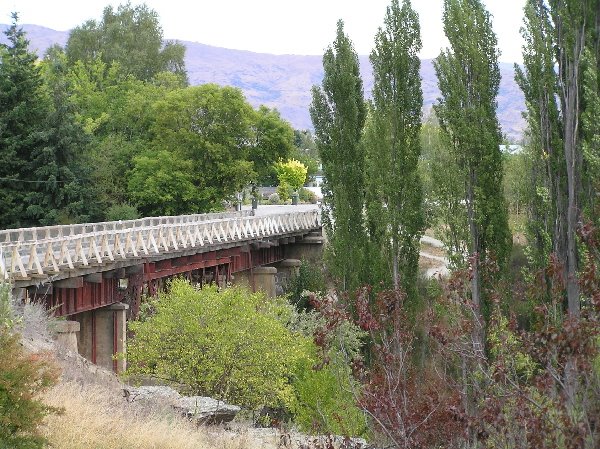
Once upon a time, in the twentieth century, a railway line ran from Dunedin to Cromwell, passing through tiny Central Otago towns and rugged river gorges.In the twenty-first century, the Dunedin to Middlemarch section of the line still lives, and a train for sightseers runs on it regularly. The Cromwell to Clyde section has disappeared under the waters of Lake Dunstan and the Clyde to Middlemarch section, now rail-less, is a motor-vehicle-free cycle route. This 150 kilometre route is called the Central Otago Rail Trail and it featured on Marcus Lush's TV series "Off the Rails". After watching the programme featuring the rail trail we were inspired to ride it and we incorporated three days on the trail into a two-week Central Otago holiday in February.
We began the rail trail experience by spending a night in the camping ground at Middlemarch, having driven there from Dunedin on a splendid sunny Waitangi Day afternoon.
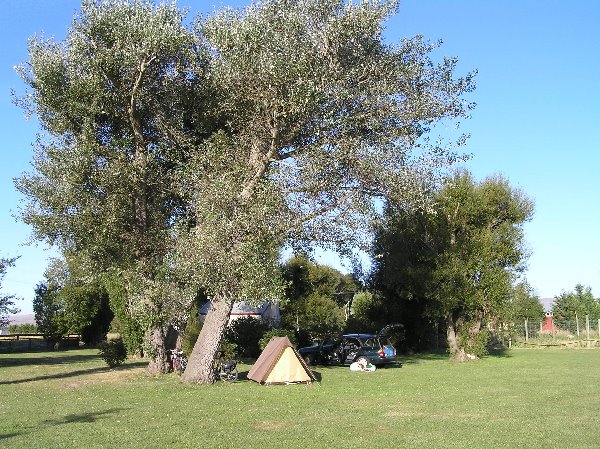 Middlemarch is 88 km from Dunedin and is technically an outer suburb - you don't pass the Dunedin City Limits sign until you get past Middlemarch, somewhere in the middle of nowhere on SH87. We had brought my aging mountain bike with us in the back of the station wagon and we hired a bike for Ian at the campground - the owners are agents for the Cycle Surgery in Dunedin who own the bikes, and also for the Catch-a-bus service which runs daily shuttles between Dunedin and Wanaka. We packed the panniers provided for 3 days of biking and went to bed.
On the morning on February, having been woken by an insomniac rooster well before dawn, we and the bikes caught the shuttle to Clyde. The day had begun cold and foggy, became bright and sunny but was cloudy and warm when we reached Clyde. The plan for day 1 was the 46km stretch from Clyde to Lauder, passing through Alexandra, Galloway, Chatto Creek and Omakau. I was a bit apprehensive because it included the steepest gradients on the trail.
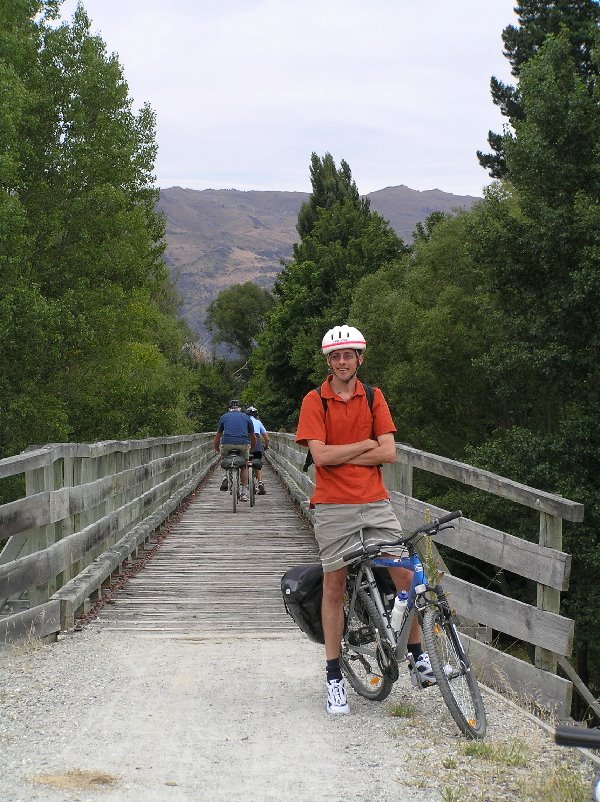
The Clyde to Alexandra section goes through orchards and is semi-rural and pleasant. It seems designed to lull you into a false sense of security about your ability to cycle 150km. The route is flat, straight and the surface is hard and smooth. We left the trail at Alexandra and had lunch in a cafe in the main street.Leaving Alexandra again we crossed some nice bridges and were cheered by the markers every kilometre that helped keep track of progress. The first marker after Alexandra said 206 and we worked out later that this is the distance back to Wingatui where the Central Otago line branches off the main trunk line just outside Dunedin. Things to admire on this part of the route include typical Central Otago rocky countryside and distant hills, sheep, deer and wildflowers.

At Omakau we deviated onto the highway so we could visit Ophir, a nice old town with historic buildings, reached by a fabulous stone suspension bridge crossing the Manuherekia River. There was almost a tantrum as I contemplated the highway heading steeply uphill, but luckily the turn-off to the suspension bridge was just before the hill.
We arrived at Lauder at 5 o'clock with me feeling I had biked slightly too far for my liking, and having learned that headwinds are a much bigger enemy to the cyclist than the hills on the trail.We stayed at the Lauder hotel, which I can't enthuse enough about. The bed was comfortable, the shower was fabulous and cookies and cups of tea on arrival particularly welcome. We met some other cyclists at dinner so we were able to compare notes, and were too tired to lament the lack of night-life.
February 8th, Ian's Birthday, dawned grey and gloomy. The day's agenda was 64km from Lauder to Waipiata, via Oturehua, Wedderburn (the highest point on the trail) and Ranfurly.
 We set off about 9am and since the route goes through the Poolburn Gorge which has tunnels and viaducts we had lots of photo stops and only travelled 6 km in the first hour.After the gorge there's a downhill section through the Ida Valley and passing the Idaburn dam which was speedy and exhilarating.We stopped for lunch a few kilometres past Oterehua at Whiskery Bill's Cafe and Bar which is handily postioned in the middle of nowhere to sustain cyclists. Lunch was delicious and proved that you can get good lattes even in the middle of nowhere. It started to rain during lunch, luckily not heavily, and the negative flavour of the afternoon was exacerbated by Ian's bike getting a puncture (a birthday treat,no doubt). Next stop was Ranfurly, and one of its claims to fame is cute art deco buildings, which we admired in addition to the contents of the art deco gallery.The final 8km of the trail for the day from Ranfurly to Waipiata was gruelling. It should have been a pleasure, being straight and slightly downhill, but a stiff headwind put paid to the pleasure.
Peter's farm hostel, where we had elected to stay, is supposedly 3km from the trail but it felt suspiciously like 5.
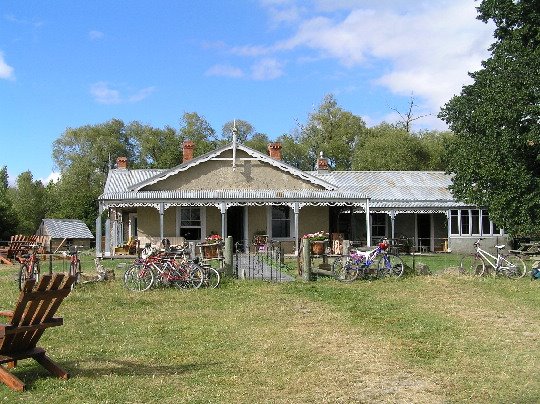 It is a very pretty mudbrick farm house with lovely timber interiors and original fireplaces but the musty smell was unattractive. The good shower was a redeeming feature and we got acquainted with it immediately.
We got back on our bikes (ouch!) to go back to Waipiata for dinner at the pub where we met more fellow cyclists. Meals there come in "town" and "country" size and the house wine (which wasn't out of a cask) was $4 a glass.Amazing! A variety of scrumptious desserts, which almost all featured chocolate, led Ian to say that the chef must be female.
Day 3 was sunny (hurrah!) and we had breakfast outside with magpies singing to add to the rurual ambience.Unlike Day 2, we met lots of other cyclists on the trail. The route goes through the Taieri Gorge,

which is particularly pretty and unlike the other sections it has lots of trees. The surface was probably the roughest we encountered, with large stones, ruts,plenty of sheep dung and a scattering of pinecones. Roughly halfway between Waipiata and Middlemarch is the Hyde cafe, where we had lunch outside with all the other bikers. Hyde to Middlemarch was a pleasure - all downhill and going fast.
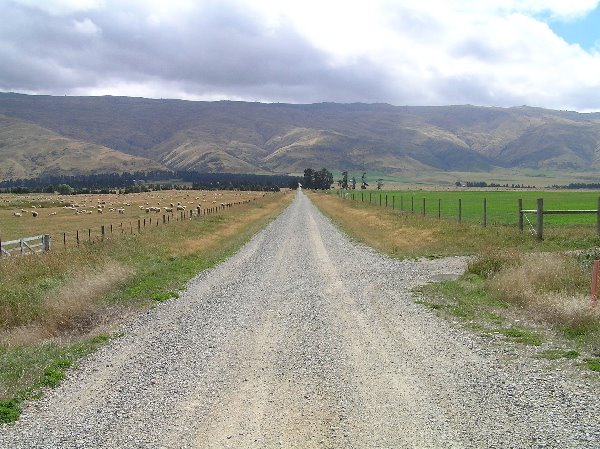
The scenery is on a grand scale with the Rock and Pillar range on one horizon and the Taieri range on the other, with a fertile plain with poplar trees in the middle. There is a slight sense of comedown when you reach the end - nothing that couldn't be overcome by a cheering crowd. Perhaps they could pay the natives to spend a few hours there each afternoon.......
So should you cycle the rail trail? I think you should, as long as you don't hate bikes.
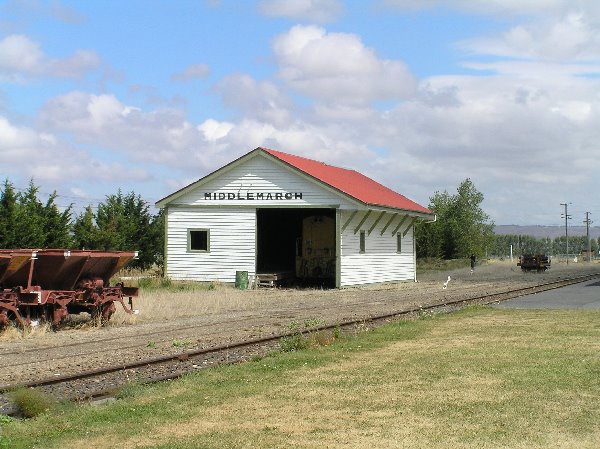 It's an opportunity to spend time in the great outdoors in a very scenic part of the country that most of us don't go to often. And you get to cycle somewhere with no cars, take great photos and meet lots of people. As to the great debate over which end to start at, I think the Clyde end is the one. Either way you're going uphill on day 1, but the Clyde end has lots of pubs and cafes to sustain you, whereas from Middlemarch its going to be a sustained long uphill with only the Hyde cafe in the first 50km. And going downhill from Wedderburn to Alex, you may speed past some bridges and scenery that deserve closer attention. Anyhow, enough from me - you can go and start planning now.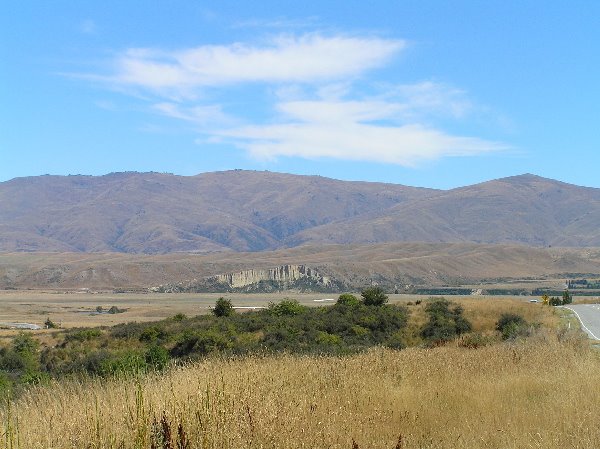
Wednesday, January 25, 2006
The World's Fastest Indian
We kicked off 2006's movie viewing with this gentle little movie about a New Zealander succeeding against the odds. There's nothing startling about it - it purports to be a film about a New Zealander going to the USA and breaking the world land speed record for a motorbike and that's exactly what it is.
There's plenty to admire, like Anthony Hopkins breaking out of his stuffed-shirt-englishman mould and doing a very good job as an ordinary kiwi bloke. I particularly liked his tendency to talk to everyone (from US Immigration officials to the motel receptionist) as if they were an acquaintance and his capturing of that complete incomprehension of the fact that most Americans have never heard of New Zealand and couldn't care less. And he'd mastered the accent quite well. The scenery was good, especially Oreti Beach in Southland and the salt lake bed they raced on in the US. Tim Shadbolt in a bit part raised a smile, as did the character that said "This will really put Invercargill on the map", because that's what New Zealanders said so many times about the film itself.
The Americans portrayed in the film were all kind and wonderful people - even Sheriffs have hearts of gold hidden behind those pointy badges - but they did seem just a touch cliche'd - the trans-sexual motel receptionist, the American Indian, the eccentric older lady who lived in the middle of nowhere - but maybe it wouldn't have been such fun for Burt to have encounters with just ordinary folk. I did wonder if this was supposed to be a film about an extraordinary New Zealander or an advertisement for the fundamental decency of the American character.
We had a pleasant evening watching this film.
Anne's rating:3/5, Ian's rating:3/5
There's plenty to admire, like Anthony Hopkins breaking out of his stuffed-shirt-englishman mould and doing a very good job as an ordinary kiwi bloke. I particularly liked his tendency to talk to everyone (from US Immigration officials to the motel receptionist) as if they were an acquaintance and his capturing of that complete incomprehension of the fact that most Americans have never heard of New Zealand and couldn't care less. And he'd mastered the accent quite well. The scenery was good, especially Oreti Beach in Southland and the salt lake bed they raced on in the US. Tim Shadbolt in a bit part raised a smile, as did the character that said "This will really put Invercargill on the map", because that's what New Zealanders said so many times about the film itself.
The Americans portrayed in the film were all kind and wonderful people - even Sheriffs have hearts of gold hidden behind those pointy badges - but they did seem just a touch cliche'd - the trans-sexual motel receptionist, the American Indian, the eccentric older lady who lived in the middle of nowhere - but maybe it wouldn't have been such fun for Burt to have encounters with just ordinary folk. I did wonder if this was supposed to be a film about an extraordinary New Zealander or an advertisement for the fundamental decency of the American character.
We had a pleasant evening watching this film.
Anne's rating:3/5, Ian's rating:3/5
Wednesday, December 21, 2005
The Constant Gardener
Is there no end to the evil perpetrated by drug companies? Once you've seen this film you'll probably think there isn't. And if you feel as I do, that Africa as a continent is doomed due to disease,drought and desperation you probably won't feel differently once you've been to The Constant Gardener. However, although this isn't exactly an uplifting film, it has a truly absorbing plot and it looks just beautiful.The flight to the Sudan passes through amazing landscapes and the miles of rusty rooves in the shanty towns in Nairobi are truly striking.
Ralph Fiennes plays a British Diplomat(Justin) stationed in Kenya. His activist wife Tessa is his antithesis - outspoken where he is reticent, frank to the point of rudeness where he is diplomatic.It seems that Tessa's great interest in life is drug companies and that his is plants.When Tessa is murdered, Justin goes through the traumatic process of uncovering why, and to what lengths the drug companies and the British Government have gone to cover up both the murder and the discoveries that Tessa had made.
Justin's friend Sandy accuses him at one point of being so involved with plants that he doesn't get properly involved with the people or events around him. In the film,life takes such a drastic turn that Justin is forced to remove his attention from gardening to Tessa's concerns and this forces him to confront disturbing possibilities.My only gripe is that he seems too self-contained. I know the British are famous for their stiff upper lips but you'd think the still birth of your first child, your wife's murder or the posthumous discovery of potential infidelity would cause a quiver or two. And how does he manage to face his own death with equanimity or fail to show relief when he learns she hasn't actually been unfaithful? In Ralph Fiennes defence maybe we don't need to see him agonising, because we know he must be in turmoil.
I'm sure you won't be bored watching this film.
Anne's rating 4/5, Ian's rating 3.5/5
Ralph Fiennes plays a British Diplomat(Justin) stationed in Kenya. His activist wife Tessa is his antithesis - outspoken where he is reticent, frank to the point of rudeness where he is diplomatic.It seems that Tessa's great interest in life is drug companies and that his is plants.When Tessa is murdered, Justin goes through the traumatic process of uncovering why, and to what lengths the drug companies and the British Government have gone to cover up both the murder and the discoveries that Tessa had made.
Justin's friend Sandy accuses him at one point of being so involved with plants that he doesn't get properly involved with the people or events around him. In the film,life takes such a drastic turn that Justin is forced to remove his attention from gardening to Tessa's concerns and this forces him to confront disturbing possibilities.My only gripe is that he seems too self-contained. I know the British are famous for their stiff upper lips but you'd think the still birth of your first child, your wife's murder or the posthumous discovery of potential infidelity would cause a quiver or two. And how does he manage to face his own death with equanimity or fail to show relief when he learns she hasn't actually been unfaithful? In Ralph Fiennes defence maybe we don't need to see him agonising, because we know he must be in turmoil.
I'm sure you won't be bored watching this film.
Anne's rating 4/5, Ian's rating 3.5/5
Tuesday, September 27, 2005
World of Wearable Art
Rachel pointed out recently that since we had called the blog "films and more" there was scope for writing about things other than films. So I thought I'd write about going to the opening night of the Montana World of Wearable Art Award Show last Friday.All the shows for 2005 are booked out but anyone reading this should definitely put it on the list of things to do next year.
This show has the kind of universal appeal that a fireworks display has because it's so good to look at. It's not a coincidence that its called WOW for short because it has loads of flair and panache and excitement. The costumes are just amazing and the choreography is great. You couldn't not like it - an hour and 45 minutes just whips past.
My favourite part was the bizarre bra section. An Elvis imported from Las Vegas stood on a podium in the centre of the stage and sang several numbers while the models jived. The girl had 3/4 length black trousers to complement their bra) and the guys wore jean with big turnups with theirs. I noticed there wasn't a hairy chest in sight,so they must have waxed - such devotion to duty! The winning bra was a pair of kiwifruit which opened up into a concertina of slices. You can check it (and other winning entries) out at http://www.stuff.co.nz/stuff/dominionpost/0,2106,0a15076a207146,00.html
Other sections were almost as enchanting. The pacifica section began with a volcano, out of which a model erupted and ascended to the ceiling in a swathe of orange silk. Another section had costumes which were designed to be viewed in the ultraviolet lights that lined the stage. There was opera music, pacific music, classical music. There was a troupe of male dancers with billowing red silk skirts and bare chests. There was a section which began with upside-down dancers in what looked like tutus, but turned out to be luminous silver dresses.Models descended from the ceiling and sported amazing tights and hats.It made enchanting viewing and it made me proud that such a creative idea was home-grwon in New Zealand.
Friday night was the actual prize-giving so famous personages (like the PM) handed out the cheques. While this was mildly diverting, I'm sure the show on other nights would be equally worthwhile.
I know this wasn't a film but it rates 5/5 anyway.
This show has the kind of universal appeal that a fireworks display has because it's so good to look at. It's not a coincidence that its called WOW for short because it has loads of flair and panache and excitement. The costumes are just amazing and the choreography is great. You couldn't not like it - an hour and 45 minutes just whips past.
My favourite part was the bizarre bra section. An Elvis imported from Las Vegas stood on a podium in the centre of the stage and sang several numbers while the models jived. The girl had 3/4 length black trousers to complement their bra) and the guys wore jean with big turnups with theirs. I noticed there wasn't a hairy chest in sight,so they must have waxed - such devotion to duty! The winning bra was a pair of kiwifruit which opened up into a concertina of slices. You can check it (and other winning entries) out at http://www.stuff.co.nz/stuff/dominionpost/0,2106,0a15076a207146,00.html
Other sections were almost as enchanting. The pacifica section began with a volcano, out of which a model erupted and ascended to the ceiling in a swathe of orange silk. Another section had costumes which were designed to be viewed in the ultraviolet lights that lined the stage. There was opera music, pacific music, classical music. There was a troupe of male dancers with billowing red silk skirts and bare chests. There was a section which began with upside-down dancers in what looked like tutus, but turned out to be luminous silver dresses.Models descended from the ceiling and sported amazing tights and hats.It made enchanting viewing and it made me proud that such a creative idea was home-grwon in New Zealand.
Friday night was the actual prize-giving so famous personages (like the PM) handed out the cheques. While this was mildly diverting, I'm sure the show on other nights would be equally worthwhile.
I know this wasn't a film but it rates 5/5 anyway.
Private
Now, we have been to more films lately than the blog would suggest, so it's clearly time to write about some. Wellington had a Middle Eastern festival in early September called the Date Palm Festival and we went several movies. The best one, I think, was Private. This is the story of a Palestinian family (Mum, Dad and five kids) who live on a hill in the West Bank, situated between an Israeli settlement and a refugee camp. Their two-storey house wouldn't win any architectural awards, being an un-preposessing concrete block box but it is a very nice home inside with all mod cons. Dad is a school headmaster and drives the kids to school in the Mercedes everyday.
The Israeli army decide to occupy the family home because of its strategic position and they take over the top floor, while allowing the family the live on the ground floor. At night, they lock the family into the lounge to sleep, and let them out again in the morning. They aren't allowed visitors, but during the day can come and go fairly freely.
The family dynamics in this movie are just great, and so is watching how each family member deals with the situations. Mum (who is alone in the house during the day with half a dozen soldiers overhead) is dying to move out. By contrast, staunch Dad would rather die than move out. Middle son arranges to move in with one of his schoolmates in the refugee camp but his father forbids it. Oldest son toys with planting a grenade in their makeshift garden greenhouse which the Israelis keep demolishing. Oldest daughter argues with her parents about their plan to send her to med school in Germany, because she'd rather "stay and fight" in Palestine. Littlest son is devastatingly cute and he struggles to understand what is going on.
Watching this film really makes you think about the different levels of publicity human rights violations get, depending on where and when in history they take place. There have been dozens of movies which feature anti-semitic atrocities in WWII, but until recently I'd never seen a movie which involved Israelis maltreating Palestinians. So, Private is well-acted, suspenseful and provides food for thought.
Anne's rating 4/5 Ian's rating 4/5
The Israeli army decide to occupy the family home because of its strategic position and they take over the top floor, while allowing the family the live on the ground floor. At night, they lock the family into the lounge to sleep, and let them out again in the morning. They aren't allowed visitors, but during the day can come and go fairly freely.
The family dynamics in this movie are just great, and so is watching how each family member deals with the situations. Mum (who is alone in the house during the day with half a dozen soldiers overhead) is dying to move out. By contrast, staunch Dad would rather die than move out. Middle son arranges to move in with one of his schoolmates in the refugee camp but his father forbids it. Oldest son toys with planting a grenade in their makeshift garden greenhouse which the Israelis keep demolishing. Oldest daughter argues with her parents about their plan to send her to med school in Germany, because she'd rather "stay and fight" in Palestine. Littlest son is devastatingly cute and he struggles to understand what is going on.
Watching this film really makes you think about the different levels of publicity human rights violations get, depending on where and when in history they take place. There have been dozens of movies which feature anti-semitic atrocities in WWII, but until recently I'd never seen a movie which involved Israelis maltreating Palestinians. So, Private is well-acted, suspenseful and provides food for thought.
Anne's rating 4/5 Ian's rating 4/5
Sunday, August 14, 2005
My Summer of Love
It bugs me that I can’t remember where I first met the plot of "My Summer of Love". It is the standard romantic plot about love between two people from different "worlds", where one character’s "world" is more powerful than the other. This time the setting is modern rural UK and the characters are two teenage girls, say fifteen or sixteen. Both girls come from unusual backgrounds and are alone for the summer. Mona’s parents are dead and she is living in a non-functional pub with her big brother. Tasmin’s parents are effectively absent and her house is miles (literally and figuratively) from its neighbours.
Tasmin is bored and Mona is frustrated. Starting with an accidental meeting, both see each other as a way out, a release. Curiosity leads to play leads to love. As is traditional with passionate infatuation stories the pace is languid, as is darkhaired Tasmin. On the other hand the freckled, red-head Mona (and her brother) are restless, tortured characters repressing a tendency to flash into violence.
Tasmin shows Mona how to see adults as toys to be played with, or at least teased and tormented. Mona’s born again Christian, ex-criminal brother and his Pentecostal congregation, looking and sounding like escapees from "Last of the Summer Wine" but carrying on like a caricature of American TV evangelists with Yorkshire accents seem like an absurdist joke, and provide an unusual backdrop for the action.
The film interplays the power of imagination and irresponsibility of childhood and the possibilities of almost adulthood with the powerlessness of being a child. The passions of first love and the usual clash of "cultures". The story moves into its last act predictably enough, but then throws in a couple of final twists of the knife.
The plot may not be original, but it is well acted by two girls who are more than just eye-candy and beautifully shot in an sunny British countryside that surely only exists in films, novels and tourist brochures. This is a good date movie or possibly girl’s night out movie, though it is not high brow enough to be a "chick-lit" film.
Ian’s rating 4/5
Anne’s rating 3/5
Tasmin is bored and Mona is frustrated. Starting with an accidental meeting, both see each other as a way out, a release. Curiosity leads to play leads to love. As is traditional with passionate infatuation stories the pace is languid, as is darkhaired Tasmin. On the other hand the freckled, red-head Mona (and her brother) are restless, tortured characters repressing a tendency to flash into violence.
Tasmin shows Mona how to see adults as toys to be played with, or at least teased and tormented. Mona’s born again Christian, ex-criminal brother and his Pentecostal congregation, looking and sounding like escapees from "Last of the Summer Wine" but carrying on like a caricature of American TV evangelists with Yorkshire accents seem like an absurdist joke, and provide an unusual backdrop for the action.
The film interplays the power of imagination and irresponsibility of childhood and the possibilities of almost adulthood with the powerlessness of being a child. The passions of first love and the usual clash of "cultures". The story moves into its last act predictably enough, but then throws in a couple of final twists of the knife.
The plot may not be original, but it is well acted by two girls who are more than just eye-candy and beautifully shot in an sunny British countryside that surely only exists in films, novels and tourist brochures. This is a good date movie or possibly girl’s night out movie, though it is not high brow enough to be a "chick-lit" film.
Ian’s rating 4/5
Anne’s rating 3/5
Thursday, August 11, 2005
The 10th District Court: Moments of Trial
"10e Chambre: instants d’audiences" is a French fly-on-the-wall documentary of parts of the proceedings of the 10th District Court in Paris. The quick verdict is that things will go worse for you if you insult parking wardens than if you drink and drive!
What you get to see is excerpts from a stream of trials for 105 minutes and then they roll the credits and you think "but… but… why did they stop there?" It didn’t really seem like an hour and three quarters. Because you don’t get to see the whole of any one trial I can’t say for certain how French District Court trials are held. But the trials seemed to follow this format: There is usually one judge and no jury (but some trials merited three people sitting up front). First the judge sums up the case and then questions the defendant, starting with name and address, but quickly moving to asking about what happened and asking the accused to give their side of the story, which the judge usually questions. Sometimes there is a civil plaintiff (in one case it was the insulted parking warden in another a policeman who had been injured arresting a pickpocket -- but not the tourist who had been pickpocketed!) who gets to say what happened to them and the judge asks them how much damages they want. Then the prosecutor makes a brief statement saying how bad the accused is and how terrible the crime was and finish by asking for a particular punishment. The defence lawyer (or the defendant) gets a turn to give excuses and suggest a lighter sentence (or ask for acquittal). Then the defendant gets sent to wait outside until sentencing at the end of the session.
The crimes are mundane: two drink driving charges, a pick pocket, calling two traffic wardens "bitches", pestering phone calls to an ex-girlfriend, carrying a shotgun in a public place, a silly case of a guy who gets into an argument the day he gets out of jail, a dodgy case of carrying an illegal weapon. The defendants are varied from the inarticulate and incoherent to one that shouts despirately and others that won't shut up, even when it is in their interest. The two middle class defendants seem to get up the judge’s nose much more than the others. The lawyers are for the most part odd, postering creatures, that play a minor part in the proceedings.
At the end of the session the defendants are brought back in and the sentences are read out. Each scene is preceded by a date and time, given that one judge heard all the trials and she was still hearing cases at 3am (and having trouble finding her way through her papers) I wouldn't care to be at the end of her case list!
On the whole this is an unusual view into side of French of life that we are highly unlikely to see otherwise and a glimpse at a justice system that is different to our own and to the fictional anglo-american justice system as we see on film and TV.
Ian’s rating 4/5
What you get to see is excerpts from a stream of trials for 105 minutes and then they roll the credits and you think "but… but… why did they stop there?" It didn’t really seem like an hour and three quarters. Because you don’t get to see the whole of any one trial I can’t say for certain how French District Court trials are held. But the trials seemed to follow this format: There is usually one judge and no jury (but some trials merited three people sitting up front). First the judge sums up the case and then questions the defendant, starting with name and address, but quickly moving to asking about what happened and asking the accused to give their side of the story, which the judge usually questions. Sometimes there is a civil plaintiff (in one case it was the insulted parking warden in another a policeman who had been injured arresting a pickpocket -- but not the tourist who had been pickpocketed!) who gets to say what happened to them and the judge asks them how much damages they want. Then the prosecutor makes a brief statement saying how bad the accused is and how terrible the crime was and finish by asking for a particular punishment. The defence lawyer (or the defendant) gets a turn to give excuses and suggest a lighter sentence (or ask for acquittal). Then the defendant gets sent to wait outside until sentencing at the end of the session.
The crimes are mundane: two drink driving charges, a pick pocket, calling two traffic wardens "bitches", pestering phone calls to an ex-girlfriend, carrying a shotgun in a public place, a silly case of a guy who gets into an argument the day he gets out of jail, a dodgy case of carrying an illegal weapon. The defendants are varied from the inarticulate and incoherent to one that shouts despirately and others that won't shut up, even when it is in their interest. The two middle class defendants seem to get up the judge’s nose much more than the others. The lawyers are for the most part odd, postering creatures, that play a minor part in the proceedings.
At the end of the session the defendants are brought back in and the sentences are read out. Each scene is preceded by a date and time, given that one judge heard all the trials and she was still hearing cases at 3am (and having trouble finding her way through her papers) I wouldn't care to be at the end of her case list!
On the whole this is an unusual view into side of French of life that we are highly unlikely to see otherwise and a glimpse at a justice system that is different to our own and to the fictional anglo-american justice system as we see on film and TV.
Ian’s rating 4/5
Up and Down
Prague may be the trendiest city in eastern Europe, but after seeing "Up and Down" you might want to go to Belgrade or Warsaw instead. The Prague of "Up and Down" is a much nastier place than the nostalgic Prague of director, Jan Hrebejk’s previous films "Cosy Dens" and "Divided We Fall". The main theme this time is racial prejudice. The Czech’s fear the gipsies and both groups are fearful of the new immigrants from further east in Europe and from Asia. Tourists are there to be stolen from and Prague is divided into unofficial racial zones of control.
There is no plot or story in the traditional sense, rather a series of episodes featuring three sets of characters. A football hooligan and his infertile child-mad wife, a sick professor and his broken and far flung family and a gang of criminals. Each set has its own episodes and acts as bystanders in the other episodes.
Ironically Franta, the man who names his cat after his favourite soccer player and cannot adopt a child because of a conviction for hooliganism, is the most sympathetic character, mostly because of his intense loyalty (to his baby stealing wife, his football club, his mates and his job as a security guard). The professor is a more fickle character with a son in Australia, a bitter estranged wife and a younger lover and daughter at home. This leads to host of family secrets and conflicts, that drive most of their episodes. On the other hand we don’t really get to know the criminals as individuals, they just play their part.
Despite the nastiness, the confusing plot lines and host of characters this is a funny film, with lots of set pieces exploring immigration from the point of view of the "natives", the recent immigrants, the not so recent immigrants, those who have left and come back and those passing through.
Ian’s rating 4/5
Anne’s rating 3.5/5
There is no plot or story in the traditional sense, rather a series of episodes featuring three sets of characters. A football hooligan and his infertile child-mad wife, a sick professor and his broken and far flung family and a gang of criminals. Each set has its own episodes and acts as bystanders in the other episodes.
Ironically Franta, the man who names his cat after his favourite soccer player and cannot adopt a child because of a conviction for hooliganism, is the most sympathetic character, mostly because of his intense loyalty (to his baby stealing wife, his football club, his mates and his job as a security guard). The professor is a more fickle character with a son in Australia, a bitter estranged wife and a younger lover and daughter at home. This leads to host of family secrets and conflicts, that drive most of their episodes. On the other hand we don’t really get to know the criminals as individuals, they just play their part.
Despite the nastiness, the confusing plot lines and host of characters this is a funny film, with lots of set pieces exploring immigration from the point of view of the "natives", the recent immigrants, the not so recent immigrants, those who have left and come back and those passing through.
Ian’s rating 4/5
Anne’s rating 3.5/5
Sunday, August 07, 2005
Hari Om
Hari Om, the second film we saw on Sunday is splendid light entertainment which you could categorize as a road movie or a romantic comedy. It is filmed in Rajastan, which is just beautiful. Camels, monkeys, elephants, the pink fort.......it is all good-looking and exotic. It's the tale of a frenchwoman on holiday in India with her boyfriend who is there on business. The day they are in Jaipur she gets bored with business and goes sightseeing by motorised rickshaw. She has such a good time she arrives late at the station and misses the sleeper train - the "palace on wheels". So she catches the bus, the bus breaks down and who should come along but the rickshaw driver, fleeing town to escape his gambling debts. So she and the rickshaw driver have some adventures before meeting up with the eventually penitent boyfriend.
The rickshaw driver is the actor who played the wedding planner in Monsoon Wedding. He vies with Gerard Depardieu for the title of biggest nose in show business, which is a bit distracting to begin with, but he does a great job in this film.
Anne's rating 4/5: Ian's rating 4/5
The rickshaw driver is the actor who played the wedding planner in Monsoon Wedding. He vies with Gerard Depardieu for the title of biggest nose in show business, which is a bit distracting to begin with, but he does a great job in this film.
Anne's rating 4/5: Ian's rating 4/5
The Queen of Sheba's Pearls
The Queen of Sheba's Pearls was one of three films we saw on Sunday July 31st.I was a bit worried about seeing three films in a row but found it very easy, despite the fact that we had to slum it in row S for all three. Row S has traditional tip-up cinema seats and isn't at all what we've become used to but never mind.
TQOSP is set in England in 1952 and centres around a boy whose mother was killed in 1944 on his eighth birthday. He lives in a huge country vicarage with the vicar (apparently no relation), his great uncle (a funeral director), his maternal grandmother, his father (works in the funeral business), a swedish chap (also works in the funeral business), and his two maiden maternal aunts who appear to be unemployed but who are bonking the vicar and the swedish chap respectively. Anyhow, into this unlikely household arrives a swedish woman who looks exactly like Jack's dead mother. This causes great consternation and rattles a skeleton or two out of some closets but gradually everyone sorts themselves out and lives happily ever after.
It was a moderately absorbing film but I'm not sure what the maker was trying to say or why it took 132 minutes to try and say it. Perhaps he was just trying to capture English people being terribly English and thought this sufficient entertainment in its own right.
Anne's rating 3/5: Ians rating 2.5/5
TQOSP is set in England in 1952 and centres around a boy whose mother was killed in 1944 on his eighth birthday. He lives in a huge country vicarage with the vicar (apparently no relation), his great uncle (a funeral director), his maternal grandmother, his father (works in the funeral business), a swedish chap (also works in the funeral business), and his two maiden maternal aunts who appear to be unemployed but who are bonking the vicar and the swedish chap respectively. Anyhow, into this unlikely household arrives a swedish woman who looks exactly like Jack's dead mother. This causes great consternation and rattles a skeleton or two out of some closets but gradually everyone sorts themselves out and lives happily ever after.
It was a moderately absorbing film but I'm not sure what the maker was trying to say or why it took 132 minutes to try and say it. Perhaps he was just trying to capture English people being terribly English and thought this sufficient entertainment in its own right.
Anne's rating 3/5: Ians rating 2.5/5
Friday, August 05, 2005
Life is a miracle
Back in our rightful home in row L, we had a good time watching this movie. It was described by one reviewer as a rom-com but romantic comedy doesn't really capture how mad this off-beat little number is. Once you've watched it you can only conclude that the residents of Bosnia are completely mad. And not just any old mad - heavy-drinking, short-tempered, lets-smash-things-for-fun mad.However, this is a charming film. The Bosnian scenery is just great and is filmed in all seasons. There are fabulous autumn colours, and beautiful snow-clad winter landscapes pink in the setting sun so it is beautiful to look at. There are cute animals - the sandwich-guzzling cat, the lovesick donkey who likes to stand on the railway tracks, the indoor bear, and the bed-loving dog. The humans around whom the story revolves are mad, as I've already mentioned,but quite engaging.
The Hero is Luka who is a Serbian railway engineer. He looks after a little branch railway line and drives a converted car along the tracks. When war breaks out in 1992 his son is called up for military service and becomes a prisoner of war soon afterwards.Luka's wife leaves him for another man, and then Luka falls in love with a Muslim nurse who he is supposed to be keeping as a hostage...........
This film is good-looking escapist entertainment with serious undertones and considers what happens when you fall in love with someone that politics say you shouldn't.
Anne's rating 4/5. Ian's rating 3/5
The Hero is Luka who is a Serbian railway engineer. He looks after a little branch railway line and drives a converted car along the tracks. When war breaks out in 1992 his son is called up for military service and becomes a prisoner of war soon afterwards.Luka's wife leaves him for another man, and then Luka falls in love with a Muslim nurse who he is supposed to be keeping as a hostage...........
This film is good-looking escapist entertainment with serious undertones and considers what happens when you fall in love with someone that politics say you shouldn't.
Anne's rating 4/5. Ian's rating 3/5
Tuesday, August 02, 2005
Birth
We went to see Birth on the night of Thursday 28th of July, which was the only night we got seriously rained on going to or from the movies in the 2 weeks of the festival. Due to the popularity of this film we were no longer in our home-away-from-home, row L, and were relegated to row P, which has armchair-style seats which aren't leather.However, we didn't suffer too much.
Birth is the story of a woman who is about to marry for the second time when she meets a ten-year-old boy claiming to be the re-incarnation of her first (deceased) husband, and of the impact this has on her, her current relationship, and her family and friends. It is quite well done and fairly absorbing but it lacks the kind of punch that I was hoping for, and that Sixth Sense has. There are a few holes in the plot, and the little boy was particularly uncharismatic, which made the whole scenario a little less convincing than it could have been.I found the soundtrack (dramatic, ballet-score type music) very irritating and I don't usually notice soundtracks. On the plus side, Nicole Kidman's acting was awesome,and the film is probably worth seeing for that alone.
Anne's rating 3.5/5, Ian's rating 3/5
Birth is the story of a woman who is about to marry for the second time when she meets a ten-year-old boy claiming to be the re-incarnation of her first (deceased) husband, and of the impact this has on her, her current relationship, and her family and friends. It is quite well done and fairly absorbing but it lacks the kind of punch that I was hoping for, and that Sixth Sense has. There are a few holes in the plot, and the little boy was particularly uncharismatic, which made the whole scenario a little less convincing than it could have been.I found the soundtrack (dramatic, ballet-score type music) very irritating and I don't usually notice soundtracks. On the plus side, Nicole Kidman's acting was awesome,and the film is probably worth seeing for that alone.
Anne's rating 3.5/5, Ian's rating 3/5
The Ax
Every film festival must have its French farce. This year the slot is filled by the "The Ax", a black comedy about middle age unemployment and the personal and social cost of downsizing. Bruno, tired of the odds against him in each job he applies for, analyses the problem and sets out to improve his chances. Identifying, locating and eliminating his competitors and then similarly creating a vacancy at the company he wants to work for.
José Garcia is the perfect, depressed, unemployed middle manager, father and husband who keeps his unorthodox strategy a secret from his wife and kids. His wife drags him off for counselling but its the son going off the rails that pulls the family back together.
This film is below standard for French comedies at Film Festivals but that still puts it above average compared to comedies on general release. I would rate "The Ax" as on a par with "The Closet".
After seeing this film you may think twice about attaching your photo to your C.V.
Ian’s rating 3.5/5
Anne’s rating 3.5/5
By the way, if you "get" the running gag about lingerie adverts, please explain it to me.
José Garcia is the perfect, depressed, unemployed middle manager, father and husband who keeps his unorthodox strategy a secret from his wife and kids. His wife drags him off for counselling but its the son going off the rails that pulls the family back together.
This film is below standard for French comedies at Film Festivals but that still puts it above average compared to comedies on general release. I would rate "The Ax" as on a par with "The Closet".
After seeing this film you may think twice about attaching your photo to your C.V.
Ian’s rating 3.5/5
Anne’s rating 3.5/5
By the way, if you "get" the running gag about lingerie adverts, please explain it to me.
Sunday, July 31, 2005
Howl's Moving Castle
Steam trams, airships, Victorian fashion, Flemish architecture, English street signs, colourful uniforms, witches, wizards and everyone speaking Japanese. Obviously we are in the world of Miyazaki Hayao animation.
It is actually more about Sophie the hat-maker than Howl the wizard. Sophie falls foul of the Witch of the Waste, and as is traditional is put under a nasty spell. Howl is a powerful wizard, gradually falling under side-effects of the magic he is using. You can probably guess where this plot is heading, though the knowing doesn’t spoil the ride. There is a rich array of side-kicks, baddies and others to entertain and frighten you along the way, in particular the witch’s gloopious minions and Calcifer the loquacious fire demon and the moving castle itself. Magic is mixed seamlessly with technology, human good and evil contrasted with magical good and evil. A visual feast for both kids and adults coupled with both adult and child messages.
If you want a movie for your kids, that you won’t find boring yourself, or you are an adult who wants something different, or are a closet Walt Disney or Finding Nemo fan or a Japanese anime cultist this is your movie. I think this is the best film of the festival.
We both rate it 5/5
It is actually more about Sophie the hat-maker than Howl the wizard. Sophie falls foul of the Witch of the Waste, and as is traditional is put under a nasty spell. Howl is a powerful wizard, gradually falling under side-effects of the magic he is using. You can probably guess where this plot is heading, though the knowing doesn’t spoil the ride. There is a rich array of side-kicks, baddies and others to entertain and frighten you along the way, in particular the witch’s gloopious minions and Calcifer the loquacious fire demon and the moving castle itself. Magic is mixed seamlessly with technology, human good and evil contrasted with magical good and evil. A visual feast for both kids and adults coupled with both adult and child messages.
If you want a movie for your kids, that you won’t find boring yourself, or you are an adult who wants something different, or are a closet Walt Disney or Finding Nemo fan or a Japanese anime cultist this is your movie. I think this is the best film of the festival.
We both rate it 5/5
Subscribe to:
Posts (Atom)

