Saturday, August 06, 2016

A Perfect Day

A slice-of-life drama, a Perfect Day is just what its title suggests - a day in the life of some aid workers in the Balkans in 1995, a day when a lot of the things that could go wrong, do.  The story centres around the search for rope to remove a body from the local well. Benicio del Toro and Tim Robbins star as the hardened long-time aid workers with Melanie Thierry playing a recent recruit. Olga Kurylenko plays a conflict evaluator. They have assorted adventures together including getting lost and having to spend the night in their utility trucks.

The film's not especially deep but does give realistic insights into potential hazards of that kind of work - lack of equipment, bureaucracy getting in the way of progress, weapons doing the talking and unexpectedly gruesome sights. The characters are likeable, the scenery is excellent, the dialogue (and indeed the film) is darkly comic. I enjoyed the recurring cow theme, the soundtrack and the journey the film took me on.

Anne's rating 3/5 Ian's rating 5/5

Les Innocentes

Like Land of Mine, Les Innocentes deals with another little-known slice of the aftermath of World War 2 but takes place in a convent in Poland rather than on the Danish Coast. It's also set in 1945, but towards the end of the year. Around nine months earlier, the retreating Russian army had paid repeated unwelcome visits to the convent and as a result a number of the nuns were pregnant As the film opens, a second nun is in labour.

Pregnancy in the convent was problematic on many levels. The Mother Superior was particularly worried about the convent being publicly disgraced so she was all for dealing with issue in-house and, for the most part, pretending it wasn't happening. Some of the other nuns were worried about their sisters dying in childbirth and, the babies being homeless. The film didn't really feature the perspective of any of the pregnant nuns, but they certainly weren't talking about their plight, and were mortified by their condition. An environment where you're discouraged from looking at or nurturing your own body would hardly make for an easy pregnancy, and there was certainly no ante-natal care.

The film opens with one of the nuns taking the initiative. Upset by distress of  her sister in labour, (the screaming echoes round the  building) she leaves the convent through a hole in the fence and walks through the forest in the snow to the nearest town to seek help from the French Red Cross. They're reluctant to help (it seems they're there to assist injured French soldiers) and want her to ask the Poles which she refuses to do since the possibility of the aforementioned public disgrace is so much greater. She manages to persuade a woman doctor (Mathilde) to come to the convent, and Mathilde ends up performing a C-section to deliver the baby

Keen to provide some post-natal care (and puzzled by the reluctance of the Mother Superior to allow it), Mathilde becomes aware of the existence of the other pregnant nuns and gets involved in trying to provide ante-natal care and of course assisting with the deliveries. She conscripts one of her male medical colleagues to assist.

Other reviews of Les Innocentes criticise the film appearing to be a docudrama about the unusual   circumstances that Mathilde finds herself working in and not presenting a viewpoint on the situation.to shape the film. I don't really agree with that - I felt that it was examining the contrasting attitudes of the Mother Superior and  her right hand woman Maria, They featured partly because they were the ones who could speak good enough french to communicate with Mathilde, and partly because they represented authority. The Mother superior was more concerned about the convent's reputation and about upholding its routine and Maria was more concerned about the welfare of the sisters and their babies. One of the film's defining moments is the Mother superior leaving one of the new babies out in the snow (leaving it to "providence" to decide the child's fate) while telling the sisters she had taken it to the mother's family. I can't really reconcile what seems like pre-meditated murder with being a bride of  Christ but I'm prepared to cut her a little slack since she had contracted syphilis from the Russian soldiers and probably wasn't on top of her game. Ditto for the decision to turn down Mathilde's offer of antibiotics to treat the syphilis. Certainly the routine life of the convent doesn't lend itself to  dealing with unforeseen circumstances like pregnant nuns, and the Mother superior has found herself in a situation she has had no experience with.

Whether or not you feel the film has a viewpoint, there's plenty of room for forming your own, particularly if you have a working knowledge of Christian doctrine and there's lot to think about afterwards. Equally you may just appreciate having your attention drawn to another group of people who suffered as a result of the war despite not fighting in it and to the people who helped alleviate that suffering. The ending is unexpectedly positive which I appreciated but some critics have felt was contrived.

Anne's rating 3.5/5 Ian's rating 3.5/5


Captain Fantastic

An unorthodox family that lives in the forest of Washington State and to some extent lives off the land with home schooled kids, who are brought up to be self reliant then has to cope with suburban America, is a good premise for humour and drama. Dad supervises their education, takes them on adventures, encourages critical thinking and leads the entertainment around the camp fire. The kids love it. Well the four girls do. Both the boys have their private doubts. The shadow over their life is that mom is in hospital in Arizona. The plot kicks off once mom dies and her father and husband argue over the funeral arrangements. This leads to a road trip and an exposure of the kids to how the rest of America lives (in particular the white middle class).


This film most strongly reminded me of Little Miss Sunshine, which is another film about an orthodox family on a road trip.

Captain Fantastic could have shown Ben leading his family on the road trip to do battle on behalf of his dead wife in the same indomitable way as he brings them up in the forest, but actually the story is more nuanced. It felt like it was pulling its punches in this department as Ben blunders and fails in his battle with his rich father in law.

The movie is part commentary on middle class suburban America from an outsider perspective and also a commentary on alternative lifestyle home schooling types. How shallow, wasteful and lazy the mainstream is and how much the alternative lifestylers depends on the rest of us. It is also a story on how the perfect dad is still fallible.

Ian's rating 3/5

Wednesday, August 03, 2016

Toni Erdmann

The Germans are not famous for their sense of humour or, as far as I'm aware their comedy films. Go for Zucker is the only German Comedy I can remember seeing so I didn't know what I was going to get with Toni Erdmann. There was also the slight concern that it was two hours and forty-two minutes long which is a pretty long time if it wasn't funny.

I think you'd call Toni Erdmann a father-daughter comedy, or perhaps an embarrassing parent comedy. Winfried (the embarrassing parent) decides his only daughter Ines is too career-oriented to be a satisfactory child and that he will go to Romania ( where she lives and works)  to sort her out. Winfried is a practical joker from way back and never goes anywhere without his joke false teeth and so a visit from him should be viewed with trepidation. He dons a wig and the aforementioned false teeth and gatecrashes a number of Ines' work functions pretending to be a life coach. Not all her colleagues are convinced , but they do play along.

Gradually Winfried does get Ines to loosen up and the film's best comedic moments ensue. Watching Ines' nude birthday brunch is a thing I will always treasure and it's worth waiting for. The delivery was mostly deadpan (unlike your average French comedy) and as its length suggests, it wasn't fast-paced. There was plenty of silliness and plenty of physical comedy to make up for the lack of speed and the film has more heart than many comedies. There are fart cushions and fake handcuffs and silly outfits and Ines' and Winfried's relationship is cemented as a result. My second German comedy was definitely a rewarding watch

Anne's rating 3.5/5

Monday, August 01, 2016

Land of Mine

Land of Mine dramatises a little-known slice of post-World War 2 history -  German POWs were assigned to clearing mines from the Danish Coast in 1945. This has a sort of poetic justice since it was the German Army that laid the mines if the first place, but if Land of Mine has anything to teach us, it's that war is generally unjust and that it brutalises both sides.

The small group of POWs in Land of Mine are only teenagers and they are scared of their job, and scared of their Danish sergeant. They're billeted on a farm on an achingly beautiful stretch of coast with white sand and turquoise water. The woman farmer is being paid by the Danish Army to feed the troops, but she just pockets the money. So the boys are hungry and the work is dangerous but on the other hand they're outdoors,the weather is ok and they're not being shot at.

 It's hard to explain why a film about clearing mines from Danish beaches is my favourite of the festival so far and why you should see it, especially since a significant number of people do get blown up. I think it's the contrast of youth and and beauty (both the landscape and the soldiers) and age and brutality. And the paradox of the sergeant bawling his charges out for minor misdemeanors (such as apologising) one minute and playing football with them on the beach in another. I can't promise you a happy ending exactly but let's say there are enough acts of human kindness to leave you with a sense of hope.

Anne's rating 4.5/5, Ian's rating 4.5/5

Friday, July 29, 2016

High-Rise

Dr Robert Laing (Tom Hiddleston) moves into his 25th floor apartment as a successful man on the way up in life. Three months later he is barbecuing a dog on the balcony. High-Rise attempts to explain this by telling us that our physical environment (the apartment building in this case) affects our behaviour, which in turn determines the structure of our society. This doesn't quite ring true as everyone has arrived in the building with a clearly recognisable place in the British class system, and the building just amplifies that class system to a ridiculous extent. It is like an adult version of Lord of the Flies. As one of the characters puts it: "What has happened when someone can fall from the 39th floor and not a single policeman turns up. Where are the sirens?" ABBA's SOS plays a prominent part in the sound track.


High-Rise is a visual riot of a film, with the apartment building in question surrounded by a sea of 1970s British cars. The building in question is post-war brutalist in and out, though some apartment dwellers have managed to recreate other interiors to try and disguise where they are living.

High-Rise has enough components (interesting premise and characters, amazing visuals, good actors, a risk taking director and a political message) to deliver a great film but it doesn't achieve its potential. Instead of an overarching plot there is an overarching idea and bunch of little sub-plots. Instead we get a surreal mishmash with recognisable bits of the 1970s presented in a (bad) dream like fashion.

Ian's rating 2.5/5

Theeb

Theeb is a Bedouin boy growing up in the small world of his clan, isolated from elsewhere by desert.
One night two strangers arrive at the camp, a British officer and his Arab guide.  They seek help to find a specific well on the old pilgrim route to Mecca. In accordance with Bedouin courtesy, Theeb's elder brother is assigned to guide the strangers and Theeb tags along. This gives the boy a ring side seat to a small and deadly drama on the fringe of General Allenby's campaign against the Ottoman Empire during World War I and the Arab Revolt.

Seeing the conflict from the point of view of an accidentally involved little boy gives a naive detached view of this aspect of the Great War, that shows the war as a foreign thing (from a Bedouin perspective) and also a glimpse into the perhaps greater changes to the Bedouin economy brought about by modern technology.


This film has been described as a Bedouin western, and given the desert vistas and the gun fight you can see why. But this is very much a child's view of a world he doesn't understand.

Ian's rating 4/5 Anne's rating 4/5


Thursday, July 28, 2016

Equity

Equity is a Wall-Street Drama with men in sharp suits and women in tight black outfits and high heels.Anna Gunn (who I know and love from Breaking Bad) plays an investment banker named Naomi, She manages Initial Public Offerings (IPOs) which involves finding institutional investors for privately held companies that are about to list on the stock exchange in order to guarantee a healthy initial share price. She's a very driven character who is under a slight cloud because the most recent of her IPOs didn't go very well. Her lover (Michael) works in a different part of the same bank, and he mingles socially with hedge-fund high flyers who are always looking for the next tit-bit of insider information.

The film is about the latest IPO, for a social media company called Cachet, Naomi and her underpaid and slightly resentful assistant Erin secure the contract and jet-set about the place looking for investors. Meanwhile, back in New York  Samantha (an old friend of Naomi's who works for the district attorney's office investigating white collar crime) is trying to dig dirt on Naomi's lover and a disaffected Cachet employee is trying to cause some trouble for the company's reputation.

So the action is all very tense and all very Wall Street. There lots of cab-catching, cocktail drinking, meetings in flash offices and watching graphs on computer screens. There's bossing people about and fishing for information. There's betrayal and undermining and each woman ( or man) is out for her or himself.

One of the things the film is trying to tell us is that no woman is an island. You can work hard, and make sure never to talk about your work to the wrong person, and keep all your passwords secure but because you don't work by yourself your co-worker failing to do all those things can cause you a big problem. And so can your customer not liking your manner or your clothes.Clothes did seem quite important. It struck me that on Wall Street men definitely get to wear the more comfortable clothes and that perhaps the next drama needs to feature someone who is both ugly and badly dressed

It was interesting seeing a drama of this kind where most of the major characters were women.   I felt we were being asked to look at the personal cost of this kind of career for women in a way we wouldn't have been asked if the major characters were men.

Equity is as much about the people as it is about the plot, so the viewer has to like the human interest angle. And since the human interest and human interaction is done really well, it's a pretty good watch,

Anne's rating 3.5/5

Tuesday, July 26, 2016

Looking for Grace

Grace is a teenager, who steals $13 000 from her parents' safe and runs away from home, leaving a note saying "sorry Mum"  Looking for Grace tells this not-very-complicated story from  five different viewpoints - those of Grace herself, her Mum Denise, her Dad Dan, retired detective Tom and a  truck driver called Bruce.
The description in the film festival programme suggests the film is about her parents enlisting the services of a retired detective and following clues to find their daughter but this credits the film with a great deal more plot than it actually has. Rather than relating the solving of a mystery, Looking for Grace is more an empathetic look at five  individuals. who have somewhat dysfunctional relationships.The writer/director (who was at the screening we went to) said the film has " a very Australian sensibility" and that it would be interesting to see whether New Zealand audiences warmed to it. I'm not sure what very Australian sensibility she meant but I'm guessing that she was referring to the not-very- demonstrative and not-very-communicative nature of the interpersonal relationships.All the characters had major secrets that their nearest and dearest didn't know about - an extra-marital affair, a child from a previous relationship, a business that wasn't financially viable to name just some. The characters, their flaws and their relationships  are conveyed sympathetically and humourously and they're pretty likeable but the film lacks much of a plot and much of a point so it's ultimately frustrating. And we never do find out why Grace's note says "sorry Mum" The trailer is a quick version of the film without the frustrating element.

Anne's rating 2.5/5 Ian's rating 3/5


Monday, July 25, 2016

A War

A Danish military outpost gets involved in the local community, as does the Taliban, things get messy and people die. Like Tobias Lindholm’s previous film A Highjacking he keeps parallel story lines running and interlacing, using international phone calls filmed from both ends. One story line in familiar territory (Denmark) and the other in exotic territory (in this case Afghanistan).


While focusing in close on the banalities of his character's lives Tobias Lindholm gets us to identify with people even if their situations are completely foreign to us. This tight focusing on particular characters also clearly divides the cast (and the world) into us and them. He then jerks the curtain aside to expose our own prejudices.

I didn't find this film as tense or as interesting as A Highjacking. The domestic life in Denmark was boring and the message of the film was hammered home with the subtlety of a hammer blow. Who are the NATO soldiers in Afghanistan actually fighting for? Does it work? Who are they trying to protect? What, if anything, is the life of an Afghan civilian worth? But the film was well acted and the characters believable, even if the message is one of despair.

Ian's rating 3/5 Anne's rating 2.5/5

Sunday, July 24, 2016

Another Country

David Gulpilil is one of Australia's most famous actors, and certainly its most famous indigenous one. He's the voice of Another Country and while he didn't write the script by himself , the politics and the viewpoint is his. Molly Reynolds and Rolf de Heer  who co-wrote the script and directed and produced the film are so familiar with how he thinks that they were able to convey it easily.

Another Country documents life in David's home town, Ramingining, not just for the sake of documenting but because it epitomises what's wrong with aboriginal communities in Australia and what's wrong with the government's management of the people that live there. It's miles from anywhere and as David says, there are no jobs and there's nothing to do.

One of the bests aspects of the film was the summaries of the differences in culture and ways of thinking between "white mans" and black fellas" culture. For example, he says that rubbish is a foreign concept to indigenous Australians - it's not on their radar and they don't know how to deal with it. Historically, everything they had came from the bush and that's where it all went back to. So a broken spear or a worn out mat was just left in the bush, and since it is all biodegradable, there isn't a problem.

He doesn't offer complete solutions but does think there needs to be consultation between the Australian Government and aboriginal communities. And the results of the consultation shouldn't just be viewed with white values and white eyes. For example, paying white builders to come and build houses may be quicker and more efficient, but it makes the locals feels worthless and doesn't take advantage of one of their great resources,  which is time.

As is often the case after watching a documentary I felt a mixture of hope and sadness. It would be good if it were compulsory viewing for all Australian members of parliament.

Anne's rating 3/5.


Friday, October 23, 2015

The Diary of a Teenage Girl

The Punisher, Sin City, The Rocketeer, Superman and The Diary of a Teenage Girl are all movies made from comics (or graphic novels).

Unlike the others which are about larger-than-life characters, The Diary of a Teenage Girl is about a fairly ordinary school girl living with her solo mum in 1970s San Francisco. Minnie is somewhat neurotic about her appearance and lack of sex-life. Left alone with her mother's boyfriend, she takes advantage of the situation to loose her virginity. Being set in 1970s San Francisco, drugs are a big feature of the film and Minnie experiments with drugs as much as she does with sex.

The narration of the film is done through the device of Minnie's audio diary, recorded on cassette tape. Some of the scene transitions are done using the cartoons that Minnie draws, which echo the origins of the film as a graphic novel, and also the drug culture of the time.

Bel Powley and Alexander Skarsgård are effective as teenage girl and adult lover, with the power in the relationship shifting back and forth between them. The setting in the 1970s feels partly familiar and partly foreign -- emphasising that things have changed a lot both in technology but also socially in the last 40 years. It is a stark contrast to the paranoia parenting of the 21st century.

Ian's rating 4/5

Wednesday, October 21, 2015

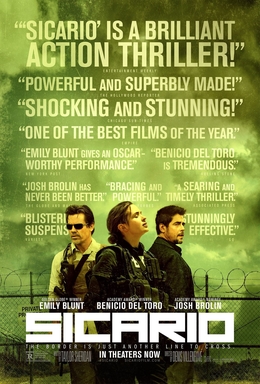
Sicario

Kate Macer (Emily Blunt) works in a police hostage rescue team in an Arizona border town. The film starts with her and a SWAT team attacking a house to rescue some non-existent hostages. But they do find a lot of dead bodies, which they think are killings ordered by a Mexican drug lord. Afterwards she is invited to join a CIA led team that is fighting the drug war at a higher level.

The team, which is mostly composed of Delta Force soldiers, take Kate on their operations including a trip to a very hostile and dangerous Mexico. She is treated as baggage by the guys, especially by Matt Graver (Josh Brolin) who recruited her and the mysterious Alejandro Gillick (Benicio del Toro). She wonders why she was asked to join.

The action is shot in pseudo-realistic way rather than the typical Hollywood action (no leaping cars, no hordes of baddies being mown down with ease). Though there is a very high useful coincidence / "cavalry showing up just in time" quotient.

This isn't a film about a female cop morphing into a crack bad-ass anti-drug gang vigilante. Rather she has trouble coping with what the guys take in their stride. Kate represents us -- law abiding middle class people, who can't hope to fight those bad Mexicans and need the guys who go beyond the law to fight the bad guys for us.

While the film has a dark edge to it. I think it enjoyed itself too much taking a Donald Trump attitude to Mexico, to take it seriously as a critique of the war on drugs There is a parallel secondary story that shows Mexican women and children as innocents, but it feels like an after thought.

Anne thought it felt like the pilot to a TV series and I see on Wikipedia that there is talk of a sequel.

Ian's rating 3/5

Monday, October 05, 2015

The Brand New Testament

The Brand New Testament is billed as a surrealist film, which should have put me off it. I have found surrealist films polarising, I love them or am very bored and confused by them. Mostly the latter.
God is alive and well and living in an apartment in Brussels with his wife and daughter, Éa. He controls events that happen (those events outside human control) with his PC from a filing cabinet lined room. To his daughter's frustration there is no door between the apartment and the world outside. Éa is keen to escape the apartment and her father's corporal punishment like her her better known older brother JC. Once she does escape she sets out to recruit six disciples and leave behind a written account of their adventures together, hence the name of the film.

Knowledge of Christianity is probably a disadvantage when it comes to watching this film. Apart from the concept that a child could confuse an overbearing parent with an adult's explanation of an omnipotent God, plus some pop culture ideas on God's responsibility for what is wrong with the world, it doesn't pay to try and dig too deeply into the premise behind this film. Just enjoy this quirky film about a girl's rebellion against her dad and her surreal adventure with a bunch of more or less abnormal people and a gorilla.
Ian's rating 3.5/5

Monday, September 14, 2015

Turbo Kid

While Turbo Kid is a Canadian film it is set in an anonymous semi-industrial, post-apocalyptic wasteland. A world were people live off the refuse of the the twentieth century, water is scarce and control of the water supply is the source of power.

Turbo Kid has its roots in an era when BMX bikes were cool and comics were read by kids, and not by middle aged men. Our hero is a young scavenger. An orphan who dreams of rescuing a girl in the manner of his favourite comic book hero. When he finally meets a girl (overly friendly and enthusiastic, pink haired Apple) he is nonplussed, but Apple's kidnap by Zeus's henchmen spurs him into action. He is reluctantly assisted by an itinerant arm-wrestling champion.

The action in this film is accompanied by BMX chases, fantastic improvised weapons, gore and fountains of blood. Some of the violence is not for the squeamish, even though it is intended to be funny.

Michael Ironside plays evil Zeus with relish, channeling the best of B-movie and James Bond villain sadism, revenge and gloating, surrounded by his BMX riding henchmen (and woman). As the man with his hand on the tap, he supplies water and sadistic entertainment to the local population. As each of his henchmen are bumped off Zeus and The Kid are brought closer and closer to face each other in the final denouement.

Turbo Kid doesn't take itself seriously. It is out to entertain us as if it were the love child of Spielberg and Tarantino.


Ian's rating 4/5 Anne's rating 3.5/5