In case you haven't worked this out yet, the current flurry of blogging is because its film festival time again. This year the festival runs from July 21st to August 6th, so right now we're a week in. Ian is realising a long-held ambition to take the film festival fortnight off work, so he is going to more films than I am and has more time to blog, but we are going to a dozen or so together and the blog is still a joint effort.
For anyone who is new to this blog, or has forgotten, the explanation of the ratings system appears in the archives for July 2005.
Saturday, July 29, 2006


Thursday, July 27, 2006
Water
Sri Lanka looks stunning standing in for an exotic, sweaty, hot, wet 1930’s India. This is a film about Hindu widows set in 1938. Widows shunned by family and society, not allowed to work or remarry or go to school. Chuyia an 8 year old child widow is an effective explanatory and message delivery device – "Where are the man widows?" is one of her many questions. She is also the only widow to not accept the situation.
Change comes through a law student who has been listening to too much Ghandi and who spots a particularly luscious and coy young widow, though one with a secret to the economy of widowhood.
As a feminist, political film it might have been more powerful if set in today’s India. But the romantic glory of the thirties makes this a stunningly beautiful film.
Ian’s Rating 4/5
Shortbus
Shortbus might become a cult film. It has the ingredients: odd, perhaps unique, riveting and flawed. The story was developed with the cast and given the amount and type of sex involved I think this was the easiest way to make the film. It also means there is a lack of overall plot or message. There are four parallel and slightly interrelated stories of sexual angst some of which get resolved at the end -- rather too quickly and neatly for credibility’s sake. Perhaps the producer rang a bell while everyone was having fun and called out ‘Time please boys and girls, you have 5 minutes to wrap this up, we have to have a climax here’. But I don’t think you are here for the stories. You are here for the sex and there is plenty of that: mostly guy on guy (on guy), but also some exhaustingly fast girl-boy, a variety of solo efforts, a dash of S&M, and general background orgies -- in fact the extras seem to be having more sex (and certainly more fun) than the protagonists at times!
Ian’s Rating 3/5 Anne's rating 3/5
Avenge but one of my two eyes
The story of Masada seems important to Israel. The Jewish revolt and military operations against Roman occupation is used as a historical precedent for a Jewish military tradition. The despair of the garrison under siege is an inspiration for Jews to never allow such a situation to be repeated. And the suicide of the garrison also requires special explanation with respect to Jewish anti-suicide theology.
The story of Samson is an even older story of Jewish strength followed by defeat, then despair and finally revenge through suicide. Samson killed more people with his suicide than he did while alive. This great Jewish hero is also remembered in Israel today through the education system, through pilgrimages and as political inspiration.
This is a documentary tells these two stories punctuated with fragments of a long rambling phone call between the film maker and an almost suicidal Palestinian friend, scenes of interactions between Israeli soldiers and Palestinian coming home from school, plough fields, going to hospital etc.
The film maker goes no further than that though he certainly isn’t pulling his punches.
Ian’s Rating 4/5 Anne's rating:4/5
The Valet
Every film festival has a French farce. This year it is ‘The Valet’ by the director of ‘The Dinner Game’ and ‘The Closet’. As you would expect from a director of this pedigree there are plenty of laughs and no false notes. A CEO (Daniel Auteuil of course) is photographed in the street with his mistress (the stunning bubbly blonde Alice Taglioni) scared of his stock owning wife (Kristin Scott Thomas) he tries to pass off the supermodel as the girlfriend of the passer by in the photo, a car parking valet (Gad Elmaleh). This far fetched plan doesn’t fool the wife who soon turns the tables and the screws on her husband, as does the increasingly disenchanted mistress. On the flip side of the story the hapless car parking attendant finds it difficult to explain his sudden, new ‘live-in girlfriend’ to his flatmate, boss, parents and his childhood sweetheart (the cute local GP’s daughter who doesn’t want to marry him but still has a sweet spot for him).
But, it almost pulls its punches. Farcical opportunities are let slip, awkward situations are magically resolved off-screen and the presence of Kristin Scott Thomas (although playing her haughty role very well) suggests to me that possibly the film makers are aiming for a less demanding possibly non-French audience. Though there is a passing reference to ‘The Dinner Game’ for you to watch out for.
Ian’s Rating 4/5 Anne's rating 3/5
Iraq in Fragments
Given how many reporters and US civilians have been killed there it is amazing that James Longley managed to film this documentary about occupied Iraq. It is in three parts. Part one is about a ten year old Sunni boy in Bagdad. He works in an auto mechanic shop and lives with his grandmother and an uncle. Failing at school, to his boss’s concern, we hear about life in Bagdad from him, his boss and their customers. Part two is about Shiite politics in the south of Iraq, the story here is a lot less personal but more directly related to the war. Part three is about a Kurdish farming family in the north, again a personal story about the choices between work and school and thoughts on politics.
While the other stories are good, part one is by far the most engaging story and worth the price of admission by itself.
Ian’s Rating 3/5
Brick
An American high school film noir murder mystery. A girl makes a mysterious phone call to her loner ex-boyfriend who finds her dead 2 days later. He sets out to find out why ahead of the bulls (cops). Everyone is an extreme stereotype: "Brains" with his thick glasses who eats lunch alone to avoid being baited, a jock with his adoring fan club, two manipulative femmes fatales to act as the school's puppet masters and a hierarchy of drug pushers, the bullying assistant VP, the oblivious parents -- refreshingly there are no cheerleaders. More than most high school films the need to attend class never gets in the way of the protagonists and their out-of-class lives make them busy people.
The plot has as many twists and turns as you would expect for a film noir and ultimately exists as much to give atmosphere as it does to drive the story. A lot of violence gets handed out but our hero Brendan has more ‘come back’ in him than a country singer and he staggers on to the end. There are some great funny scenes especially when the film maker reminds us from time to time that these people are just school kids. The other vital ingredient that puts this film into the must see category is the dialog. Trying to understand the jargon and slang is as much part of the fun as trying to second guess the plot turns.
It is worth going out of your way to see this.
Ian’s Rating 5/5
Worldly Desires
This is the sort of film that puts ordinary people off film festivals. It looks like it was shot on a home video by someone who is unfamiliar with focus. It is made up of disconnected shots some looking like the camera was accidentally left on and edited together in an incomprehensible manner. There are shots of the making of a music video, shots of the film crew setting things up, putting them away, eating lunch and waiting about and some film of a couple running through the bush. There is no coherent dialog. A waste of $5.50.
Ian’s Rating 0/5
Heading South
A film about middle age white women going to Haiti to be pampered and serviced by young black men may sound titillating -- and it is. Nice male bodies, ambiguous situations, flirtatious dialog, verbal cat fights as the women compete for the most desirable men. The Haitian characters gradually move from the background to compete with the white middle aged female tourists for our attention, and the focus of the film moves from the personal concerns of the women to the juggling act of a life of their favorite hunk. Edges of darkness gradually permeate the film in the second half and the finale is like watching a slow train wreck. We can see the inevitable before all the players do.
Being Haiti the dialog is mostly in French and sub-titled. The sex is mostly described or off screen rather than seen. It is a film about people rather than pretty scenery and as one character says the difference between the black men in Alabama and those in Haiti are that the Haitian men are not wearing shirts – which some might say is a form of scenery worth paying to see!
Ian’s Rating 3/5
Ghost in the Shell
There are two ways to watch Ghost in the Shell. One is to follow the story, work out who is doing what to who and why, which ones are the good guys and which ones the bad. To do this it helps to understand that "ghost" is used to mean "soul" or "consciousness" rather than "scary dead thing". The heroine, Kusanagi, and her colleagues are a special semi-secret all powerful police division that is part of the Ministry of Foreign Affairs. Most of these special agents have had body modifications, in some cases whole new bodies. Between operations Kusanagi worries whether, with all her body modifications, she is still human. The division’s top priority becomes the "Puppet Master" and via an escalatingly violent series of operation Kusanagi comes face to face with the "Puppet Master" and the metaphorical mirror image of her own situation and her worries are turned on their head by the "Puppet Master's" request.
The other way to watch this is to allow the experience to wash over you. It is a vision of ultimate high-tech domination of nature. Man totally manufacturing his own environment. But it is also tinged with paranoia and uncertainty. Twentieth century buildings are abandoned or are slums. Its a teenage boy’s dream world where the best secret cop is more curvaceous than a centrefold and her job requires her to eschew the flack jackets or long coats of her male counterparts in favour of getting naked during every ambush and fire fight! A world where technology is all powerful, is used to solve every problem and is concentrated in the hands of a few.
Ian’s Rating 4/5
Thursday, May 18, 2006
Sione's Wedding
It has finally happened! A cheerful, life-affirming film has been made in New Zealand, by New Zealanders, about New Zealanders.The nation should celebrate, and it's residents should go and see this film.
Sione's wedding it ground-breaking for lots of reasons. It's about Samoans and for me the list of Samoan films I've seen is even shorter than the list of cheerful New Zealand films I've seen. As I already mentioned, it's a happy movie. It's scenically beautiful, and entirely filmed in Auckland. And its a chickflick for blokes.
Sione's wedding is a romantic comedy about four guys who have been banned from attending their friend's wedding unless they come with a date (i.e. a civilising influence). So they each have a week to find a girl and their exploits over the week keep the watcher very much amused. We see each of the heroes overcoming their weaknesses and making it to the wedding with seconds to spare. We get to enjoy lavalavas, taro leaves and umu packs making it to the big screen, and we get to enjoy Auckland at its golden sun-kissed best. The palangis don't come off so well, but who cares?
This film has great dialogue, it's well-acted and it looks great. Off you go!
Anne's rating 4/5 Ian's rating 3/5
Tuesday, March 28, 2006
Syriana
If you were after action, gorgeous women or character development you've come to the wrong film. This is a political morality tale. It falls into the same category as "The Constant Gardener" but without that film's beautiful camera work. But it does try to make up for it in other ways. There is an attention to detail, how often do you see several overs of a cricket match in an American movie? Distinctions are made between Muslims from different countries, and not everyone speaks English.
Syriana deals with US oil business and politics through a large cast of stereotype, cardboard cut-out characters in four slowly converging story lines. The acting is competent, but as there are no meaty parts, there isn't a chance for any of the actors to shine, nor draw attention away from the political message. Normally such one-dimensional characters would be the sign of a poor film but here it works. The characters are not important, we are not meant to fall in love with them. The four story lines give you different views of the same events, though each is the story of peripheral character who through circumstances outside their control gets to see up close, an inside view of a small part of an oil deal.
What rescues Syriana from being a B-grade TV movie is the lack of exposition. You need to concentrate from the opening credits to figure out what is going on. It is refreshing not to be spoon-fed. Even so I didn't understand George Clooney's character's last action. Tell me if you can understand it.
I rate it a 3/5
Anne thought it was too slow and rates it 2.5/5
Sunday, March 12, 2006
Central Otago Rail Trail
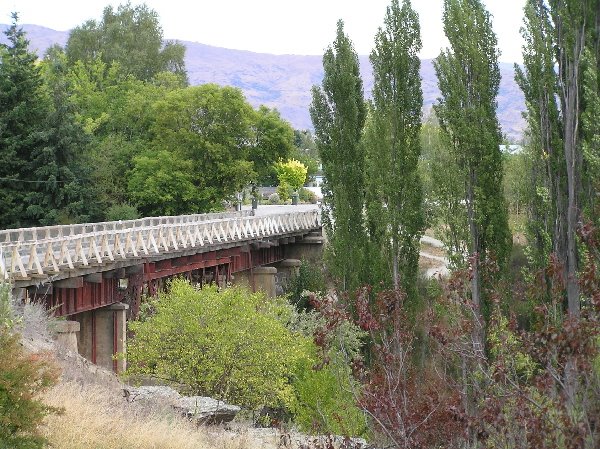
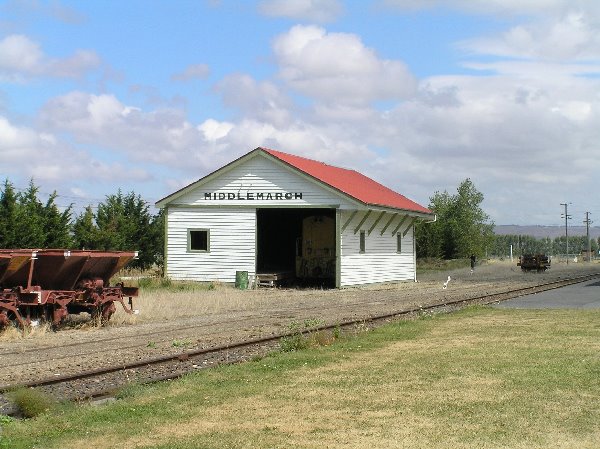
Once upon a time, in the twentieth century, a railway line ran from Dunedin to Cromwell, passing through tiny Central Otago towns and rugged river gorges.In the twenty-first century, the Dunedin to Middlemarch section of the line still lives, and a train for sightseers runs on it regularly. The Cromwell to Clyde section has disappeared under the waters of Lake Dunstan and the Clyde to Middlemarch section, now rail-less, is a motor-vehicle-free cycle route. This 150 kilometre route is called the Central Otago Rail Trail and it featured on Marcus Lush's TV series "Off the Rails". After watching the programme featuring the rail trail we were inspired to ride it and we incorporated three days on the trail into a two-week Central Otago holiday in February.
We began the rail trail experience by spending a night in the camping ground at Middlemarch, having driven there from Dunedin on a splendid sunny Waitangi Day afternoon.
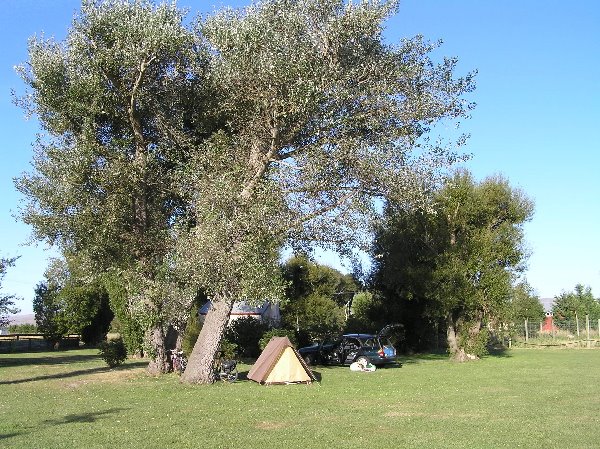 Middlemarch is 88 km from Dunedin and is technically an outer suburb - you don't pass the Dunedin City Limits sign until you get past Middlemarch, somewhere in the middle of nowhere on SH87. We had brought my aging mountain bike with us in the back of the station wagon and we hired a bike for Ian at the campground - the owners are agents for the Cycle Surgery in Dunedin who own the bikes, and also for the Catch-a-bus service which runs daily shuttles between Dunedin and Wanaka. We packed the panniers provided for 3 days of biking and went to bed.
On the morning on February, having been woken by an insomniac rooster well before dawn, we and the bikes caught the shuttle to Clyde. The day had begun cold and foggy, became bright and sunny but was cloudy and warm when we reached Clyde. The plan for day 1 was the 46km stretch from Clyde to Lauder, passing through Alexandra, Galloway, Chatto Creek and Omakau. I was a bit apprehensive because it included the steepest gradients on the trail.
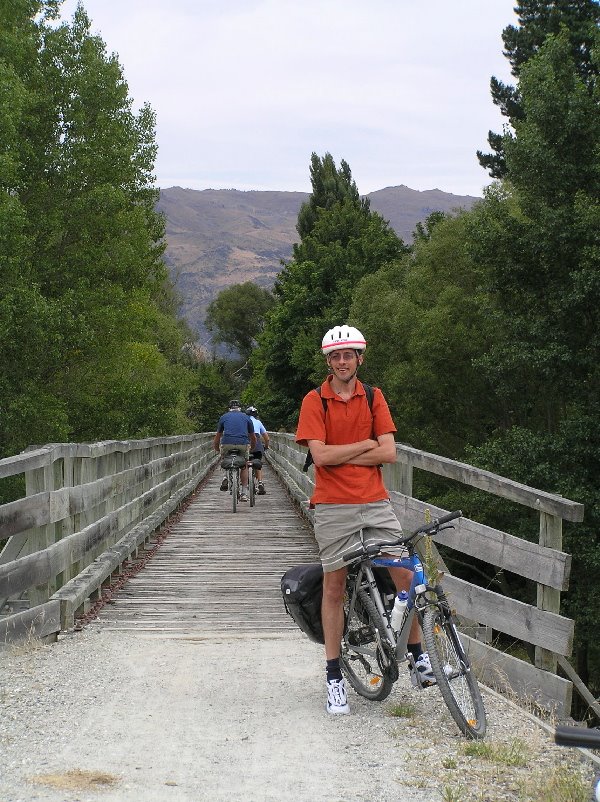
The Clyde to Alexandra section goes through orchards and is semi-rural and pleasant. It seems designed to lull you into a false sense of security about your ability to cycle 150km. The route is flat, straight and the surface is hard and smooth. We left the trail at Alexandra and had lunch in a cafe in the main street.Leaving Alexandra again we crossed some nice bridges and were cheered by the markers every kilometre that helped keep track of progress. The first marker after Alexandra said 206 and we worked out later that this is the distance back to Wingatui where the Central Otago line branches off the main trunk line just outside Dunedin. Things to admire on this part of the route include typical Central Otago rocky countryside and distant hills, sheep, deer and wildflowers.

At Omakau we deviated onto the highway so we could visit Ophir, a nice old town with historic buildings, reached by a fabulous stone suspension bridge crossing the Manuherekia River. There was almost a tantrum as I contemplated the highway heading steeply uphill, but luckily the turn-off to the suspension bridge was just before the hill.
We arrived at Lauder at 5 o'clock with me feeling I had biked slightly too far for my liking, and having learned that headwinds are a much bigger enemy to the cyclist than the hills on the trail.We stayed at the Lauder hotel, which I can't enthuse enough about. The bed was comfortable, the shower was fabulous and cookies and cups of tea on arrival particularly welcome. We met some other cyclists at dinner so we were able to compare notes, and were too tired to lament the lack of night-life.
February 8th, Ian's Birthday, dawned grey and gloomy. The day's agenda was 64km from Lauder to Waipiata, via Oturehua, Wedderburn (the highest point on the trail) and Ranfurly.
 We set off about 9am and since the route goes through the Poolburn Gorge which has tunnels and viaducts we had lots of photo stops and only travelled 6 km in the first hour.After the gorge there's a downhill section through the Ida Valley and passing the Idaburn dam which was speedy and exhilarating.We stopped for lunch a few kilometres past Oterehua at Whiskery Bill's Cafe and Bar which is handily postioned in the middle of nowhere to sustain cyclists. Lunch was delicious and proved that you can get good lattes even in the middle of nowhere. It started to rain during lunch, luckily not heavily, and the negative flavour of the afternoon was exacerbated by Ian's bike getting a puncture (a birthday treat,no doubt). Next stop was Ranfurly, and one of its claims to fame is cute art deco buildings, which we admired in addition to the contents of the art deco gallery.The final 8km of the trail for the day from Ranfurly to Waipiata was gruelling. It should have been a pleasure, being straight and slightly downhill, but a stiff headwind put paid to the pleasure.
Peter's farm hostel, where we had elected to stay, is supposedly 3km from the trail but it felt suspiciously like 5.
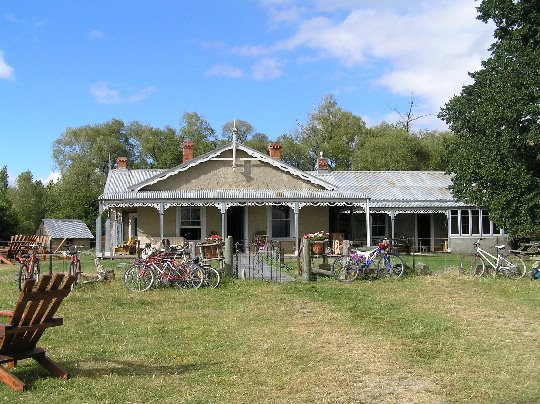 It is a very pretty mudbrick farm house with lovely timber interiors and original fireplaces but the musty smell was unattractive. The good shower was a redeeming feature and we got acquainted with it immediately.
We got back on our bikes (ouch!) to go back to Waipiata for dinner at the pub where we met more fellow cyclists. Meals there come in "town" and "country" size and the house wine (which wasn't out of a cask) was $4 a glass.Amazing! A variety of scrumptious desserts, which almost all featured chocolate, led Ian to say that the chef must be female.
Day 3 was sunny (hurrah!) and we had breakfast outside with magpies singing to add to the rurual ambience.Unlike Day 2, we met lots of other cyclists on the trail. The route goes through the Taieri Gorge,

which is particularly pretty and unlike the other sections it has lots of trees. The surface was probably the roughest we encountered, with large stones, ruts,plenty of sheep dung and a scattering of pinecones. Roughly halfway between Waipiata and Middlemarch is the Hyde cafe, where we had lunch outside with all the other bikers. Hyde to Middlemarch was a pleasure - all downhill and going fast.
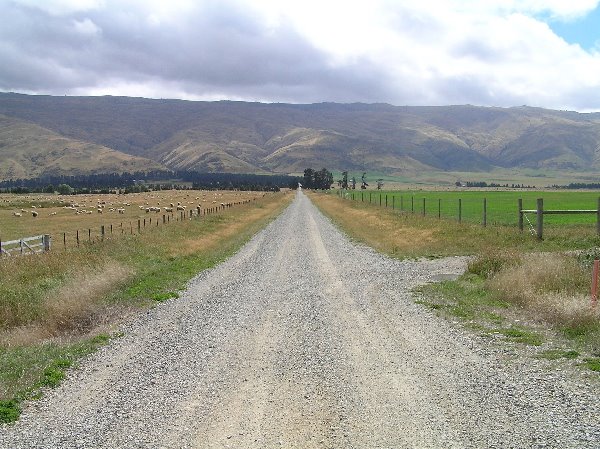
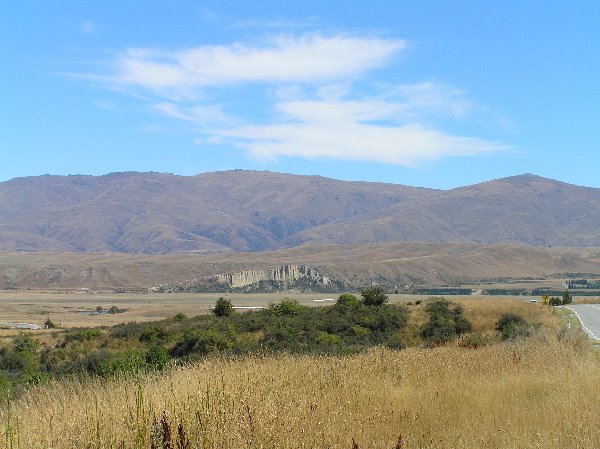
The scenery is on a grand scale with the Rock and Pillar range on one horizon and the Taieri range on the other, with a fertile plain with poplar trees in the middle. There is a slight sense of comedown when you reach the end - nothing that couldn't be overcome by a cheering crowd. Perhaps they could pay the natives to spend a few hours there each afternoon.......
So should you cycle the rail trail? I think you should, as long as you don't hate bikes.
 It's an opportunity to spend time in the great outdoors in a very scenic part of the country that most of us don't go to often. And you get to cycle somewhere with no cars, take great photos and meet lots of people. As to the great debate over which end to start at, I think the Clyde end is the one. Either way you're going uphill on day 1, but the Clyde end has lots of pubs and cafes to sustain you, whereas from Middlemarch its going to be a sustained long uphill with only the Hyde cafe in the first 50km. And going downhill from Wedderburn to Alex, you may speed past some bridges and scenery that deserve closer attention. Anyhow, enough from me - you can go and start planning now.
Wednesday, January 25, 2006
The World's Fastest Indian
We kicked off 2006's movie viewing with this gentle little movie about a New Zealander succeeding against the odds. There's nothing startling about it - it purports to be a film about a New Zealander going to the USA and breaking the world land speed record for a motorbike and that's exactly what it is.
There's plenty to admire, like Anthony Hopkins breaking out of his stuffed-shirt-englishman mould and doing a very good job as an ordinary kiwi bloke. I particularly liked his tendency to talk to everyone (from US Immigration officials to the motel receptionist) as if they were an acquaintance and his capturing of that complete incomprehension of the fact that most Americans have never heard of New Zealand and couldn't care less. And he'd mastered the accent quite well. The scenery was good, especially Oreti Beach in Southland and the salt lake bed they raced on in the US. Tim Shadbolt in a bit part raised a smile, as did the character that said "This will really put Invercargill on the map", because that's what New Zealanders said so many times about the film itself.
The Americans portrayed in the film were all kind and wonderful people - even Sheriffs have hearts of gold hidden behind those pointy badges - but they did seem just a touch cliche'd - the trans-sexual motel receptionist, the American Indian, the eccentric older lady who lived in the middle of nowhere - but maybe it wouldn't have been such fun for Burt to have encounters with just ordinary folk. I did wonder if this was supposed to be a film about an extraordinary New Zealander or an advertisement for the fundamental decency of the American character.
We had a pleasant evening watching this film.
Anne's rating:3/5, Ian's rating:3/5
Wednesday, December 21, 2005
The Constant Gardener
Is there no end to the evil perpetrated by drug companies? Once you've seen this film you'll probably think there isn't. And if you feel as I do, that Africa as a continent is doomed due to disease,drought and desperation you probably won't feel differently once you've been to The Constant Gardener. However, although this isn't exactly an uplifting film, it has a truly absorbing plot and it looks just beautiful.The flight to the Sudan passes through amazing landscapes and the miles of rusty rooves in the shanty towns in Nairobi are truly striking.
Ralph Fiennes plays a British Diplomat(Justin) stationed in Kenya. His activist wife Tessa is his antithesis - outspoken where he is reticent, frank to the point of rudeness where he is diplomatic.It seems that Tessa's great interest in life is drug companies and that his is plants.When Tessa is murdered, Justin goes through the traumatic process of uncovering why, and to what lengths the drug companies and the British Government have gone to cover up both the murder and the discoveries that Tessa had made.
Justin's friend Sandy accuses him at one point of being so involved with plants that he doesn't get properly involved with the people or events around him. In the film,life takes such a drastic turn that Justin is forced to remove his attention from gardening to Tessa's concerns and this forces him to confront disturbing possibilities.My only gripe is that he seems too self-contained. I know the British are famous for their stiff upper lips but you'd think the still birth of your first child, your wife's murder or the posthumous discovery of potential infidelity would cause a quiver or two. And how does he manage to face his own death with equanimity or fail to show relief when he learns she hasn't actually been unfaithful? In Ralph Fiennes defence maybe we don't need to see him agonising, because we know he must be in turmoil.
I'm sure you won't be bored watching this film.
Anne's rating 4/5, Ian's rating 3.5/5
Subscribe to:
Posts (Atom)

