Sunday, August 11, 2019

Births, Deaths & Marriages

Dean doesn't show up for his own wedding leaving Sinead pissed off but this is overshadowed by grandma dying later the same day meanwhile, Katherine has had a contraction. Set over 2 days in 1994, Births, Deaths & Marriages is about a mostly female Upper Hutt family coping with these situations. These goings-on are recorded on a home-video camera by Aidan who was originally supposed to film the wedding.

Births, Deaths & Marriages is a bunch of humourous short set-pieces often set in claustrophobic locations such as the bathroom. We also see recognisable Kiwi attitudes and reactions, familiar from our friends, relatives and possibly ourselves. The quality of the humour is highly variable, with some of the exchanges much better than others. The exchanges between the very pregnant Katherine and her husband Ari over Irish wakes versus Maori tangi and a lecture on stages of grief are the standouts. On the other hand, there were a number of scenes and minor characters that could have been eliminated to improve the film. The way the scenes were linked by a blank screen and out of focus bits while the soundtrack continued also got irritating. And it seemed odd that on day 2 the bride was still in the bath.

If I had been trapped in that house with that family, I would have grabbed some of the wedding food, climbed out of the window and headed for Wellington.

Stuff had a more positive review.

🎥

Ian's rating 2/5 Anne's rating 2/5

The Gangster, the Cop, the Devil

The Gangster, the Cop, the Devil is not an imaginative film title, but at least we have a pretty good idea what the film is about. Detective Jung Tae-seok is a tough, cynical cop who has a personal vendetta again powerful gangster Jang Dong-soo. He puts 2 and 2 together when investigating a random killing of guy found stabbed to death in the back of his car. He decides this murder has a similar M.O. to a couple of older crimes in other towns and decides there is a serial murderer to be caught. His wild theory is not taken seriously, even when Jang Dong-soo is attacked when driving home one night. The gangster fights back and survives the attack, thinking he'd been attacked by a hitman sent by a rival starts a gang war and also sends his men out to look for the assassin. The cop notices that both cars had been hit from behind by a white car and realises that Jang Dong-soo is the only person to have seen the serial murderer's face. Eventually, the erstwhile enemies join forces to hunt down the killer who has become more reckless, killing more frequently and not changing location like he used to.

The Gangster, the Cop, the Devil is a stylish South Korean action crime thriller. The cops are unkept, the police station dingy and crowded, while the gangsters are stylish, impeccably dressed and vicious. While the presentation is stylish, the scenario and plot are as original as the title. It is best to go along for the ride rather than look for novelty or a deeper message. But this is no different from many Hollywood films that do well at the box office. The Gangster, the Cop, the Devil stands up well alongside those films.

I think that the downfall in The Gangster, the Cop, the Devil is the serial killer - "the Devil". Surely the idea of the uber-villain should be confined to cinematic and TV history. The idea that a single man (and it is almost always a man) who can out-think and outmanoeuvre the cops, often depicted as planning things years in advance, setting up elaborate one-off schemes and having limitless resources as his disposal yet having a secret room where he pins pictures of his victims and future victims to the wall along with newspaper clippings and decorated with his primitive art that lays bare his inner thoughts and as a shrine to his evil crimes is completely ridiculous. The serial killer in The Gangster, the Cop, the Devil is a ruthless, knife obsessed loner, whose main defence is his anonymity and that his kills have been in different police districts, with long gaps in time between them. Once he starts to kill more frequently and staying in the same area, he should have ceased to be the formidable opponent he was built up to be.

The best scene is a throwaway scene where we are shown a potential female victim only to have our expectations amusingly upended in a unique insight into the idea that one of the protagonists may have a life outside work.

🎥

Ian rating 3/5

Friday, August 09, 2019

The Art of Self-Defense

You are an American guy that has been mugged.
A) Do you buy a gun?
B) Do you enrol in a self-defence class?
Casey (Jesse Eisenberg) faces this decision on his voyage of self-improvement and recovery. Option A is represented by a gun shop salesman with a disturbingly honest sales pitch.
The risk of accidental death drastically increases with a gun in the home. … In a violent confrontation, an armed victim is much more likely to be killed than an unarmed victim. Suicide is more common with gun owners too.

You’re really going to love owning a gun.
Option B is a small Karate Dojo with rituals, 11 rules and students ranging from small kids to intimidating macho brown belts.

The Art of Self-Defense is a remarkably dry, dark comedy populated by everyday, normal characters who are completely over the top. For those that like their comedies to have a serious message, this is not one of those films. This is a film of absurd situations and deadpan one-liners, with the best delivered with impeccable timing and seriousness by Alessandro Nivola as Sensei of the Karate Dojo, but even Casey's answerphone gets in on the act "No one else left you a message". Eisenberg's face, mask-like one moment and quivering with emotion the next plays well against Nivola's impenetrable seriousness.


The Art of Self-Defense has been my favourite film of the 2019 film festival so far and the audience reaction in the Embassy suggests that I wasn't the only person to enjoy it.

🎥

Ian's rating 5/5

God Exists, Her Name Is Petrunya

In Macedonia, on 19 January they celebrate the Baptism of Jesus Christ (Vodici or Epiphany), priests throw a cross into a river or lake and the person who gets it first is blessed. In Stip in 2014 a woman got to the cross first, it was grabbed from her by a male contestant and the police were called. This was the inspiration for God Exists, Her Name Is Petrunya.

Unfortunately, due to writing the wrong time on the calendar, I missed the first 25 minutes of the film and arrived at the point where Petrunya is in the river having had the cross snatched off her. While filmed by a TV crew the priest intervenes and she gets the cross back from the crowd of angry young men who think it is wrong for a woman to have participated and more importantly got to the cross first. Petrunya takes the cross home, has a fight with her mother and locks herself in her room to gloat over her victory (perhaps her first since graduating with a first-class history degree 10 years earlier). The police arrive and take her to the police station to "sort things out" - which takes the rest of the film.

The priest is there, insisting that Petrunya has broken "the rules", privately the police chief points out that the priest's "rules" aren't the same thing as the Law. The police chief attempts to brow-beat Petrunya about breaking "the rules" anyway while admitting that she is not under arrest but at the same time insisting that she has to stay. The arguments (or lack of them) go round and round, with Petrunya taking a passive but defiant stance and gaining in self-confidence. Outside a mob of angry young men and a TV reporter are trying to get into the police station.

Unfortunately having reached an interesting intersection of girl power, patriarchy, secular power, tradition, religion and angry youth (youth unemployment is over 40% in Macedonia) God Exists, Her Name Is Petrunya can't find a satisfactory way forward, ending anticlimactically - which may be the point.

🎥

Ian's rating 2.5/5

Thursday, August 08, 2019

Take Me Somewhere Nice

Where does Alma keep her cellphone? In Take Me Somewhere Nice, we often see her making calls, but we never see her put it away. She has no pockets or bag (or at least not one she can open) and she doesn't carry it in her hand. Take Me Somewhere Nice is not a fast-paced film so there is plenty of time to think about relevant and irrelevant questions like this. It is not a plot driven film, but road trip movie and depiction of teenage life. So periods of boredom punctuated by brief periods of action and emotion is entirely appropriate.

Alma was born in Bosnia but raised by her mother in the Netherlands. Hearing that her dad is in hospital, Alma decides to take a solo trip to Bosnia to visit him. She arrives in Sarajevo to stay initially with her grumpy, dodgy, unhelpful and mostly absent cousin Emir. On the other hand, Emir's more talkative friend Denis perks up Alma's stay in Sarajevo and prods Emir into some belated assistance. Despite being unfamiliar with Bosnia, Alma has the confidence to strike out on her own across the country without the skills to avoid trouble and with her little blue dress serving to emphasizes that she is a damsel-in-distress (or soon to be in distress). She gets rescued by knights in shining armour of both genders and varying motives. Alma's luggage problems and the consequent need to wash, dry and wear the same clothes all the time become a running gag in the film. Similarly, Alma's technique for dealing with guys is simple, effective and repetitive. Bosnia is depicted as a place where somethings don't seem to have changed since communist times.

The camera in Take Me Somewhere Nice always seems to arrive shortly after the action starts and often cuts away before it finishes. This coupled with some of the odd plot twists and scenes lends the film an absurdist vibe. Nothing special to see here, but nothing bad either. There is plenty of dry humour and a few moments of tension.

Not only does Alma have a cellphone that is invisible when not in use, unlike real teenagers she only uses it for phone calls. Like kids from the 1970s, Alma, Emir and Denis are more fixated by Bosnian TV than by their cellphones.

🎥

Ian's rating 2.5/5

Wednesday, August 07, 2019

The Nightingale

Jennifer Kent is best known for her controversial horror film The Babadook. Her latest film is set in Tasmania during the convict era and centres around Clare an Irish convict who has served her time, got married to another Irish ex-convict, had a baby but can't leave the tiny settlement she lives in until the lieutenant in charge writes her release letter. She works as a servant and singer and the whole garrison, from Lt Hawkins down, openly lusts after her. Clare is near the bottom of the social pecking order, constantly at risk of harm to her and her family, while trying to insist on her right to be treated as a free person. A visit from a more senior officer starts the chain of events that brings down an avalanche of violence on Clare. With nothing left to lose except her life, Clare sets out to into the bush with Billy (a reluctant Aboriginal tracker) to get revenge on the Lieutenant (who left with a small contingent a few hours earlier). The film follows the two groups through the bush to Launceston. While initially a backdrop to Clare's story, the war against Aboriginal Tasmanians becomes the second theme of the film and Clare's initial attitude to Billy is no different to the soldiers' attitude. As Billy explains his history, Clare slowly begins to see him as a fellow victim.

The Nightingale doesn't shy away from violence and the body count here rivals a Quentin Tarantino film. The film is a rollercoaster with each rise in fortune followed by a crashing fall. This isn't a happy story, it is one that asks us to understand the use of violence and whether violent revenge puts an end to the original violence or just creates a cycle and an excuse to continue with violence.

🎥

Ian's rating 4/5

Monday, August 05, 2019

A white white day

When someone you're close to dies, maybe you go through a "process",  or the seven stages of grief, or maybe grief is different for everyone. A white, white day is a depiction of a grief-stricken man named Ingimundur. He's an retired policeman (or maybe he's on extended bereavement leave - it's hard to tell), and he's recently widowed. On the surface, he's doing everything right.  He has a project  (converting a rural building into a house), he spends meaningful time with his grand-daughter, he catches up with his old colleagues, sees his friends and his brother and plays football. He goes to weekly grief-counselling, organised by the police.

Unfortunately, he discovers that his wife was being unfaithful, and this leads to,  firstly, a period of detective work, and secondly to a period of madness where he attempts to deal with the discovery.

During the period of madness, Ingimundur attacks his old work colleagues and puts them in the cells which has to be one of the most amazing fight scenes I've watched. And he kidnaps the man he thinks his wife was having sex with , and makes him confess at gunpoint. He reduces his eight-year old grand-daughter to tears more than once. By the end of the film, there's been true catharsis but surprisingly,  I was left with the sense that Ingimundur will be ok, and that no-one will hold his madness against him.

Ingimundur is on the screen practically every moment, and his grand-daughter Salka is on it about eighty percent of the time. They're both completely convincing and compelling. The film is a great watch, and there's an incredible tension,  created by wondering how far over the edge Ingimundur is going to go.

An added bonus is seeing cute Icelandic ponies, and some completely dreadful Icelandic children's TV.

Anne's rating 4.5/5 Ian's rating 3.5/5


Sunday, August 04, 2019

Monos

Phrases such as "Like Lord of the Flies", "Apocalypse Now on shrooms", "In the place of warfare are bizarre rituals, horny hook-ups and campfire raves", and "a tense, off-kilter deep dive into corrupted innocence that never quite goes where you think it will" lowered my expectation of Monos.

Monos has the most diverse set of actors I have seen in a long time. Which is handy in an ensemble film, where 8 to 10 characters are sharing the spotlight and dialogue is sometimes sparse. Eight child soldiers are left on a bare mountain top to guard an American hostage by their roving commander (who is shorter than some of his young soldiers). The teens belong to a rebel group whose ideology and aims are never explained. The views from this vantage point above the clouds are spectacular. But there is not a lot of soldiering to do, so plenty of time bored teenage mischief. But in the second half of the film, things change gear. The soldiers and their hostage move down into the rain forest. We only get vistas from drone footage, the characters inhabit a much more damp and claustrophobic world where you can rarely see more than 2 or 3 metres in any direction. Group dynamics change when their prisoner makes a break for freedom. Loyalties are challenged and the body count mounts.

We are tempted to take sides but is anyone on the side of the angels? Director Alejandro Landes keeps us guessing and keeps reminding us that these are both kids and killers. While not a great film it was better than I expected when I found my seat. Visually interesting, thrilling, twisted and morally ambiguous.

🎥

Ian's rating 3/5

Thursday, August 01, 2019

Aniara

Are two sci-fi films about people travelling for a long time on spaceships in the same film festival a coincidence?

Aniara is a Swedish film based on an epic poem from 1956 about a huge spaceship carrying people from a dying Earth to Mars but after an accident it goes way off course. While High Life has a small functional spaceship, Aniara is like a combination of hotel and shopping mall (like a cruise ship but much larger). The passengers are mostly white, middle-class families. The protagonist, calling herself MR, is a Mimarobe, a crew member in charge of a machine called the Mima that reads minds and replays favourite memories to the passengers to relieve anxiety.

Aniara (the film) is divided into titled chapters that chart the stages that the passengers and crew go through in response to the vastly extended voyage. Each stage is illustrated by a subplot or some scenes mostly involving MR and others such as her roommates or the captain. This dystopian progression takes precedence over plot or characters so we don't know them or feel any more attached to them than we do to Star Trek's redshirts. The glossy surroundings also distance us from their predicament. Though there is plenty to think about with the various stages and strategies that the crew and passengers use to cope with the situation, which is an analogy for the fate of our planet.

🎥

Ian's rating 2.5/5

Wednesday, July 31, 2019

High Life

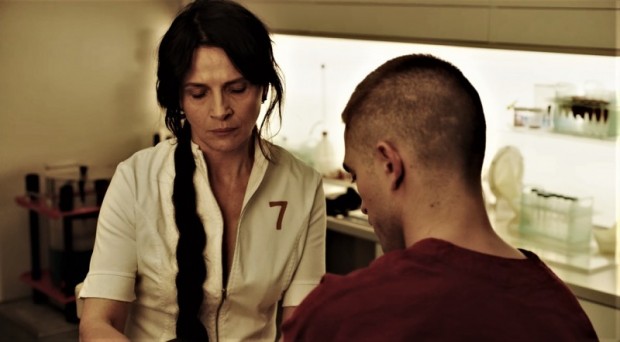
Starting with an astronaut alone on a spaceship with a baby girl, most of High Life is flashbacks on how we got here. You shouldn't go into a Claire Denis film expecting everything to make sense. Though you should expect the camera to spend a lot of time watching the actors doing stuff. But in High Life we eventually get most of the back story. Scientists have come up with a way to transfer some of the energy from a black hole to earth. Unfortunately, the trip to the nearest suitable black hole to set up the system will take a long time, effectively making it a one-way trip. So a crew of convicts serving long sentences is recruited, including a disproportionally large number of sociopaths. There is not much to do in space and the doctor (Juliette Binoche) is experimenting with artificial insemination when she isn't playing with her long hair and flirting with the gardener, Monte (Robert Pattinson). Sex and the lack of sex is an underlying theme in this movie which is more about the crew than the mission.
Which unfortunately means once Denis has killed off almost all the crew and our curiosity about the past has been satisfied there is very little material left for the final act. It feels like the writers didn't know how to finish the film and (at the risk of being lynched by fanboys and girls gnashing their dentures and waving their walking sticks at this comparison) like 2001: A Space Odyssey the plot peters out.
There is one possible further storyline for the film to explore and while it is hinted at near the end as the baby girl grows up, perhaps that idea is too extreme even for Claire Denis.

🎥

Ian rating 2/5

Judy & Punch

I have never seen a Punch & Judy puppet show. I'm too young and/or too far removed from the United Kingdom. It is one of those things that hover on the edge of my cultural consciousness, alongside pantomime, Dune, Engelbert Humperdinck and Halloween. I recognise the name and some of its aspects (such as Punch’s crescent moon-like profile, familiar from Dad's magazines) but not enough detail to understand it.

Set somewhere and sometime in the past, Judy & Punch is a fictitious origin story for Punch & Judy shows and a revenge story for Judy. Punch is a marionette showman with a drinking problem, dreaming of taking the show to the big smoke, his wife Judy is trying to hold things together. The small town they live in has a witch problem. Of course, killing witches does not reduce the number of townsfolk discovered to be witches.

Leaving Punch to look after their baby, a string of sausages on the table and small dog Judy goes out to run some errands. Even a cursory knowledge of Punch & Judy will clue you into what happens next and to Punch's reaction to being confronted. Punch's inability to take responsibility for anything piles up the victims in a dark second act. Here the writer/director's inexperience led to an unsatisfactory third act. Reaching into the hat of worn-out Hollywood tropes, we get quickfire: "resurrection from (apparent) death", "rescue by Ewoks" (a secret society of outcasts living in woods), "wisdom from Yoda" (a wise old medicine woman), "pleasant interlude with the outcasts", "dream sequence", "ignore wise advice to take revenge", "rescue and revenge", "happy ending with idyllic social order established". Though there is a coda where the transition from marionettes to hand puppets is explained.

Underlying the film is an anti-alt-right message. Concentrating on misogyny, on emotional arguments over rational ones, on violence as a solution (though that last one gets undermined in the end).

Ian's rating 2/5

Sunday, July 28, 2019

Fly By Night

Do you like your gangland boss to chuckle and gloat over his victims? Do you like your detective to be cool and suave? Do you like to see your protagonists trapped in an impossible situation? Fly By Night ticks all these boxes and more. While there is nothing new in the plot, it more than makes up for that in style and tension. The protagonists are a small family taxi company in Kuala Lumpur which supplements its income with slick an extortion racket that operates below the radar of both the local gangsters and the police ... until a mark unexpectedly escalates things and one of the boys is a sore loser at the neighbourhood casino bring the family to the attention of the owner (played by Frederick Lee channelling Jack Nicholson in a scenery-chewing performance). Meanwhile, Inspector Kamal is lazily circling the family like an inquisitive shark.

Fly By Night film poster
Who is who?
It took a few minutes to work out the relationships between the characters at the start of the film and the ending is ambiguous. But otherwise, this is an enjoyable, often funny ride where, like a traditional noir, no-one is good - even the wronged girlfriend. The action scenes are sharp. There is no shortage of violence. And New Zealand gets mentioned a couple of times.

🎥

Ian's rating 3.5/5

Saturday, October 27, 2018

A Kid Like Jake

Jake is the only child of professional parents in the suburbs of New York City. He's five and his parents are looking for a primary school for him. The kind of primary school they'd like to send him to probably costs more than they can afford, and only takes a limited number of children anyway, so it's quite a source of anxiety.


One of the significant things about Jake is that he's quite effeminate for a small boy. He likes to dress up, has moderately long hair and likes pastel colours and movies about unicorns. His kindergarten principal suggests that his parents should emphasize this in their primary school applications, since schools like to think they're accepting a diverse range of students and that he might even get a scholarship as a token gender-diverse child.

A Kid Like Jake is about his parents response to this idea and the effect that this has on their relationship with each other, their friends and with Jake.The dilemma of how much emphasis to put on an aspect of your child's personality and identity is portrayed convincingly and is easy to relate to. Life can always throw something at you that you weren't expecting and it's interesting to see a couple dealing with the unexpected.It's quite a talky movie but it is entertaining and it's nice to look at, especially since Jake's parents are played by Claire Danes (Alex) and Jim Parsons (Greg). And although Alex and Greg don't agree on everything, it's not at all harrowing to watch.

Anne's rating 4/5 Ian's rating 2.5/5

Saturday, August 25, 2018

Three Identical Strangers

A good documentary should tell you stuff you didn't know and be engaging while it does it. This film has a pretty interesting premise,  triplets separated at birth who grew up not knowing they were triplets, who meet at the age of nineteen.

Once this basic scenario has been played out, the story just gets more interesting. It becomes apparent that the adoption agency hid the fact that these children were triplets from their adoptive parents. I won't go into the reasons now, because you may wish to watch the movie yourself, but it's fair to say that your jaw will be on the floor quite often.

We meet the two surviving triplets, and many of their friends and relatives. We meet people who worked for the adoption agency (which specialised in Jewish babies) and child psychologists and researchers.


Adoption is much rarer in the twenty-first century than it was in the nineteen-sixties, at least in the western world and is much more regulated and transparent. Once you've watched this movie you'll probably think this is a good thing.

Anne's rating 3.5/5

Thursday, August 23, 2018

The Insult

Two political Lebanese courtroom dramas in one festival sounds like more than a coincidence.

The Insult opens with a Christian Phalangist Party rally celebrating election victory. Tony Hanna, who owns a car repair garage is a keen party follower. The next day he gets into an altercation with Yasser the Palestinian foreman/engineer doing renovation work on the apartment building, which quickly escalates into Tony smashing a new drain pipe and Yasser calling him a "fucking prick" (or some Arabic equivalent). The situation escalates between the two stubborn and proud men leading to a worse insult ("I wish Ariel Sharon had wiped you all out"), a punch, court cases and a national political drama, with rock throwing and burning tyres.
The court case is a device to provide not only more tension between the two sides but also allows explanation of the past (including Black September and  the Damour massacre). Tony's lawyer, in particular, is an even more ardent supporter of the Maronite Christian cause than Tony is. He resents that Palestinian suffering at the hands of Zionism shelters them from criticism and sees the case as yet another opportunity to undermine their reputation (to what end is unclear as there is no way that Lebanon can ever get rid of Palestinians, since that depends on the Israelis).

The Insult makes the point that what we identify with gives us strength but also makes us a target. Also that emphasising one difference prevents us from seeing what makes us similar in other ways. It does a good job of explaining a small part of Lebanon's history. The personal tension between the two men is very well depicted with Yasser smouldering quietly and stiffly while Tony's agitation is more physical. Similarly the legal dispute is in the long tradition of cinematic courtroom tactics.
As the lawyers wrangle over the case the two men at the centre of it begin to feel left out and try solve their differences outside the courtroom. At about this point there are a couple of scenes that don't fit with the plot and how Yasser and Toni appear to feel at that moment. Both scenes have dramatic appeal and from that point of view I can see why they are in the film, but both feel jarringly out of place at that point. One, involving the President of Lebanon, might have fitted better earlier in the story and the other involving a car that won't start perhaps nearer the end.

Politics in Lebanon is a high tension game. A country which divides its electorates not only geographically but also between 18 religious groups. Where political parties have militias. A country which has had a civil war. On top of that Lebanon has hosted refugee camps for 70 years and where at the moment 1 in 3 people are refugees from conflicts in neighbouring Syria, Israel or Palestine. Neighbouring countries that show no sign of accepting their refugees back. There is no lack of bitterness and no lack of causes to join. Despite that The Insult is a hopeful film. There are an abundance of peace makers among the minor characters: Yasser's boss and his wife, Tony's pregnant and photogenic wife (played by Rita Hayek) and the President of Lebanon.

🎥

Ian's rating 4.5/5 Anne's rating 3.5/5

The World Is Yours

This year's French comedy is the crime caper The World is Yours which, strangely, has two French titles Le monde est à toi and Le monde ou rien. If you want a nice, polite, politically correct French farce you should move along, there is nothing to see here.

Our protagonist longs to go straight and dreams of opening a Mr. Freeze franchise in North Africa and owning a small house with an outdoor pool. Unfortunately, his family and friends are the criminal underworld of the local Parisian housing estate and his career so far has been committing, aiding and abetting crime. Even when he thinks he has saved enough for a down payment on the franchise his mother's gambling habit intervenes. So he reluctantly accepts the job of driving to Spain to pick some drugs from a Scottish drug lord. Accompanied by his mother's dopy ex-boyfriend, 2 stoned gangsters both called Mohamed and a gold digging semi-girlfriend what could possibly go wrong? And who are you going to call when things do go wrong? Well, mummy of course (played in top scenery chewing form by Isabelle Adjani).

While not the funniest or craziest film at the festival, it has a flare that is missing in the rest of the films I saw in this year's festival. Reminiscent of both Tarantino and Sexy Beast, The World is Yours has us rooting for the underdog as he digs himself deeper and deeper into trouble.

🎥

Ian's rating 3/5 Anne's rating 2.5/5

Wednesday, August 22, 2018

Disobedience

I went to Disobedience because I enjoyed the book, which isn't always a good idea but worked out all right on this occasion. It probably helps that it's quite a few years since I read the book, so I wasn't hung up on the details.

Ronit  (played by Rachel Weisz) is  the central character. She is a rabbi's daughter and grew up in London in an orthodoxe Jewish community but now lives a secular life in New York City working as a photographer. Having heard the news of her father's death, she heads back to London, where she finds out that Dovit (who was her father's spiritual protege) and Esti (her best friend with whom she had a clandestine lesbian relationship when they were teenagers) are now married to each other which is a big surprise. The other big surprise waiting is that her father has left his house to the local synagogue and not to her.

Despite Esti being married, she and Ronit's feelings for each other haven't diminished with time. So the story is about what effect that has on each of their adult lives and how Ronit comes to terms with the death of a man she loved, but from whom she was estranged. It's a very tense movie and the tension comes from the impossibility of having or acknowledging a lesbian relationship in such a religious community. Disobedience is a fairly satisfying watch despite everything in it (including the weather) being gray or brown.

Anne's rating 3/5.

Monday, August 20, 2018

Ava

Ava is an sixteen year old high school student in Tehran. She plays the violin, hangs out with her friends, experiments with make up and has a bit of thing for her friend's brother, with whom she plays duets. The high school she goes to is girls only and somewhat repressive. A harmless afternoon spent with the aforementioned brother results in her being taken by her mother to the gynaecologist for a virginity assessment, which she's naturally pretty upset about, particularly when she discovers that her mother was pregnant when she got married. Her supportive and seemingly fairly liberal parents are suddenly part of the repressive and paranoid regime that operates at her school.

So Ava the movies paints a picture of a society that most Westerners are uncomfortable with. We mourn that Ava has to go through what she does, and that her parents are complicit in putting her through it. Unfortunately, Ava the girl isn't a very charismatic character and the whole film is a bit grim. Watch the trailer so you get the gist, but don't bother to go to the film.

Anne's rating 1/5

Sunday, August 19, 2018

Capharnaüm

Capharnaüm or Capernaum is a confusing title. Merriam Webster defines capharnaum as a confused jumble or a place marked by a disorderly accumulation of objects. While chaos is an apt description of the situations the title really doesn't do justice to this political film about the effect on children of poverty and poor parenting decisions.

Ostensibly Capharnaüm is a courtroom drama as approximately 12-year-old Zain sues his parents in a Lebanese court. But this is just a framing device for telling the story in an extended flashback. The story of a few weeks of Zain's life and family and by extension the story of the bottom rungs of Lebanese society, especially its children. Zain's parents can't remember what year he was born. He has a lot of siblings and being the eldest still at home he feels responsible for the others, especially his 11-year-old sister Sahar. The family lives in a small, dirty apartment owned by a local shopkeeper who has the hots for Sahar and for whom Zain works for as a delivery boy. Zain's mother runs a small-time drug smuggling operation involving the kids, who also sell juice to commuters at rush hour. Zain's father's occupation is not mentioned.

As bad as the initial situation is it gets worse when Zain runs away from home in anger after an unsuccessful attempt to protect Sahar. Eventually, Zain ends up living on the streets trying to look after a refugee toddler when its mother disappears, presumably arrested.
Much of the cast are not previously professional actors and Zain, in particular, who is in almost every scene pulls off an amazing performance. His character's resourcefulness, cynicism, anger and compassion drive the story. While the subject matter is depressing, this is not really a depressing story. Zain's go-with-your-gut instinct approach to life is too much fun to watch. I can only dream of coping with the bad things in life with the aplomb that he does.

Other reviews are divided into those that say that Capharnaüm is too sentimental and emotionally manipulative and those that say it is unsentimental and gritty (and in defence point out that emotional manipulation is at the core of filmmaking). I wonder if the divide is actually between those that were made uncomfortable and wanted to dis the film and its message versus those who accept the dual attack on parents and the system that leads to poverty and refugees. I presume that director Nadine Labaki (who has a bit part in this film and previously started in 2008's Caramel) made this film for a Lebanese audience, a country with 4 million Lebanese and 2 million refugees (mostly from Syria). We are not used to hearing from Lebanese about refugees, which contrasts with the endless reports crisis caused by 1 million Syrian and African refugees arriving in the EU with its population of 500 million.

Ian's rating 5/5 Anne's rating 4/5

Saturday, August 18, 2018

Foxtrot

It was back to Israel for Foxtrot, but this time for was a Jewish Israeli film, Like Wajib it was a family drama, but unlike Wajib it features Jewish Israelis and we're talking a funeral rather than a wedding.

Foxtrot centres on a middle-aged Israeli (Michael) who lives with his wife  (Dafna) and two young adult children (Jonathon and Alma) in a high-rise apartment in Tel Aviv. Jonathon is currently serving in the IDF and is stationed in the north of Israel. The film opens with a knock on the apartment door and it's two soldiers, announcing that Jonathon has been killed. They're coy about the details, and suggest that viewing the body is unnecessary and undesirable. They act with impressive efficiency - you get a sense of the IDF being an unstoppable well-oiled machine

So we view the family's different reactions to the news, get to meet a few other relatives and get to know people a bit better. Michael's mother is a holocaust survivor who's losing her memory, Michael served in the IDF himself.

Then the first plot twist - the soldiers are back, announcing they got things wrong, and although a Jonathon Feldman has died, it isn't their son. So now there are different kinds of angst to go through. Initially Michael and Alma are fighting, later they find some  mutual consolation in their joint confusion and anger.

Then it's off to the north of Israel and seeing Jonathon's  day-to-day existence. He and three fellow solider live in a container and monitor an isolated checkpoint. There's very little going on but there's some drama when they're inspecting a carful of young Arabs and they mistake a beer can for a grenade and open fire, killing all the occupants. In an almost surreal scene, the ever-efficient IDF sends a massive truck with a bulldozer on the back and the car and everyone in it is buried
 forthwith.And then we have a second plot twist which you can see for yourself if you go to the film.


One of Foxtrot's main messages is that serving in the IDF is bad for you - mentally and physically. You get caught up in. it, and it changes you forever. A sub-message is that surviving the holocaust blights your relationships. And while these are not the cheeriest messages, it was a pretty engrossing watch. Foxtrot was directed by Samuel Moaz who directed Lebanon (set inside an Israeli tank in the 1982 war with Lebanon) which we have also seen,

Anne's rating 3.5/5